
Key Takeaways
- The ASO salary may seem attractive at ₹80,000, but real savings often drop below ₹40,000 due to high living costs.
- A Reddit discussion highlights the disparity between ASO salary expectations and actual financial reality, especially in metro cities.
- Many ASOs struggle with expenses like rent and food, which significantly cut into their disposable income.
- Comparison with private sector salaries and social media lifestyles exacerbates the disappointment felt by many ASOs.
- Government jobs provide benefits such as job security and fixed hours, challenging the notion that salary alone determines job value.
“₹80,000 salary sounds great, right? But many SSC CGL ASOs say they save less than ₹40,000. Here’s the real story no one tells you.” The SSC CGL ASO salary reality is very different from what most aspirants imagine. While the SSC CGL ASO salary in hand 2026 looks impressive on paper, the actual picture becomes clearer when we look at ASO salary after expenses.
Whether it’s ASO salary in Delhi vs other cities or comparisons like SSC CGL salary vs private job, understanding the real scenario is important before deciding: Is SSC CGL ASO worth it?
But a recent Reddit discussion on r/SSCCGL shows a different side of the story. A first-hand account by a candidate sparked an honest debate about whether the ASO Salary actually delivers the lifestyle many aspirants expect.
This article looks at that discussion closely and explains why many officers feel that the salary looks good on paper but feels underwhelming in real life.
What is the official salary of an ASO?
An Assistant Section Officer is placed at Pay Level 7. On paper, the ASO Salary Per Month structure looks impressive:
| Salary Component | Amount / Details |
| Basic Pay | ₹44,900 |
| Dearness Allowance (DA) | As per current government rates |
| House Rent Allowance (HRA) | Depends on city category (X, Y, or Z city) |
| Transport Allowance | Applicable as per posting city |
| Other Benefits | Medical facilities, pension contribution, paid leave |
In X category cities like Delhi, Mumbai, or Bengaluru, the in-hand salary usually reaches around ₹75,000 to ₹80,000 per month after allowances.
For most aspirants preparing for SSC exams, this figure becomes a major motivation. It feels like a ticket to financial comfort and social mobility.
What triggered the reddit discussion?
The Reddit thread titled “ASO’s salary feels disheartening” was posted by a user who had either joined or closely observed ASOs working in metro cities.
The user wrote that while the salary looks strong on paper, real savings are much lower once expenses are counted. One line from the post summed up the concern clearly:
“On paper the money seems handsome (eg. 80k/month approx. net salary) for X city but the living cost there is too high (they are spending 15–20k on rent only). So, net disposable income is far less (<40k–45k).”
This observation resonated with many readers, especially those already posted in metro cities.
ASO Salary Per Month
An Assistant Section Officer (ASO) falls under Pay Level 7. Here’s the typical breakdown:
| Salary Component | Amount |
| Basic Pay | ₹44,900 |
| DA | As per govt rates |
| HRA | ₹10,000 – ₹27,000 |
| Transport Allowance | ₹3,000 – ₹7,000 |
| In-Hand Salary | ₹75,000 – ₹80,000 |
How much does an ASO actually spend every month?
Several users replied with realistic expense breakdowns to explain where the salary goes. One comment shared a simple monthly calculation:
“82k in hand, rent 15k, transport 5k, food 12k, internet 500, electricity 2k, rest miscellaneous. By the end of the month I am left with much less.”
Rent alone consumes a large portion of income, especially in cities like Delhi where decent accommodation near offices is expensive. Add daily commuting, food costs, and family responsibilities, and the scope for savings narrows quickly.
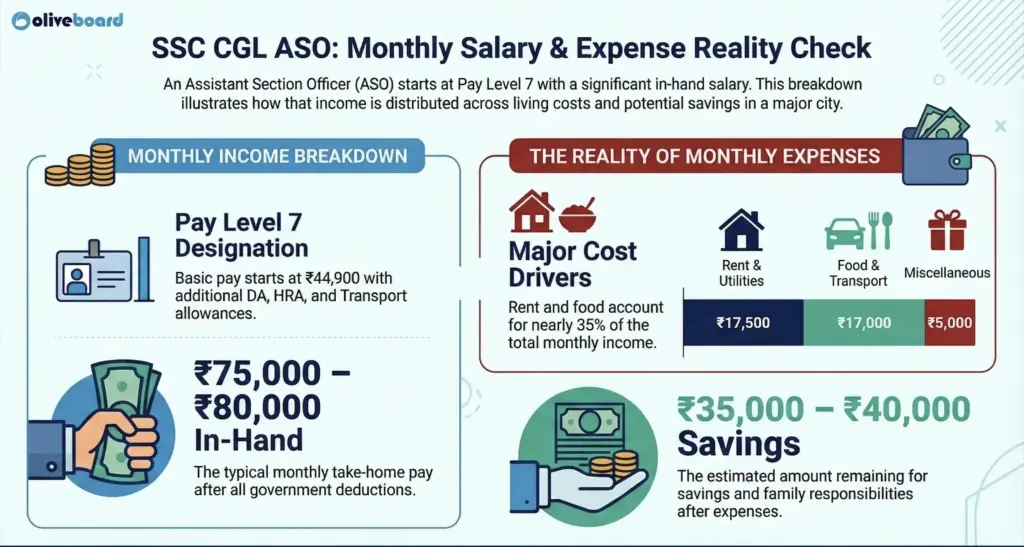
ASO Salary after expenses (Reality Check)
To understand the SSC CGL ASO salary reality, below is a realistic monthly breakdown:
| Category | Amount |
| Salary | ₹80,000 |
| Rent | ₹15,000 |
| Food | ₹12,000 |
| Transport | ₹5,000 |
| Electricity + Internet | ₹2,500 |
| Miscellaneous | ₹5,000 |
| Savings | ₹35,000 – ₹40,000 |
Is the disappointment about luxury or basic comfort?
Some commenters initially assumed the original poster was expecting a luxury lifestyle. This led to pushback from others who felt expectations were unrealistic. One user commented:
“If you define basic life as foreign trips, parties every weekend and constant shopping, then no salary will ever feel enough.”
However, the original poster clarified their point and stressed that their expectations were modest.
They responded:
“I have enough basic sense to know that those are luxuries, not necessities. What I meant is that the actual amount that Group B officers are able to save at the end of the month is quite meagre.”
They further explained that they were talking about simple joys like eating out occasionally, taking parents for dinner, or planning a short family trip once in a while.
SSC CGL ASO vs Private Job Salary
Choosing between a government job and a corporate career is a common dilemma among aspirants. This comparison of SSC CGL ASO vs Private Job Salary highlights key differences in growth, stability, and work-life balance to help you make an informed decision.
| Factor | ASO | Private Job |
| Salary Growth | Slow | Fast |
| Job Security | High | Low |
| Work Pressure | Moderate | High |
| Work-Life Balance | Good | Often Poor |
ASO Salary in Delhi vs Other Cities
The ASO salary in Delhi vs other cities varies significantly due to differences in rent, cost of living, and lifestyle expenses. While metro cities offer higher allowances, they also come with higher spending, impacting overall savings.
| Factor | Delhi / Mumbai (X Cities) | Tier 2 / Tier 3 Cities |
| Salary (HRA Benefit) | Higher | Slightly Lower |
| Rent & Living Cost | Very High | Low |
| Lifestyle Expenses | High | Moderate |
| Savings Potential | Lower | Higher |
Why does the salary feel less than expected?
The Reddit discussion highlights several deeper reasons behind the dissatisfaction.
High Cost of Living in Metro Cities
Most ASO postings are in large cities. Rent, food, transport, and daily expenses in metros have risen sharply in recent years. Even a salary close to ₹80,000 struggles to keep pace with urban inflation.
Salary Expectations Built During Preparation
During exam preparation, aspirants often hear that ASOs earn “80k per month”. Over time, this figure becomes a mental benchmark for comfort, without enough discussion about expenses and deductions.
Comparison with Private Sector peers
Many candidates compare themselves with friends working in IT, consulting, or startups. Social media posts showing frequent travel, gadgets, and dining out add to the feeling that government salaries lag behind.
One commenter summed this up well:
“When you compare your first stable government salary to curated social media lifestyles, you are bound to feel disappointed.”
Are government jobs still worth it then?
Despite the disappointment, several users reminded readers that salary is only one part of a government job. Many pointed out benefits that do not show up in monthly bank statements:
- Job security
- Fixed working hours
- Low stress compared to many private jobs
- Pension and long-term stability
- Respect and authority
Some users also noted that ₹75,000 to ₹80,000 per month still places an ASO well above the national average income, even if it does not feel lavish in metros.
Do family situations change the experience?
Yes, significantly.
Users mentioned that single officers or those living in government accommodation often manage comfortably. However, married officers or those supporting parents feel the pressure more.
A recurring suggestion in the comments was that dual income households make life much easier. When both spouses earn, the same salary suddenly feels more comfortable.
What can aspirants learn from this discussion?
The Reddit thread is not a warning against SSC CGL or ASO posts. Instead, it acts as a reality check. It shows that:
- A government job does not automatically mean a high-end lifestyle
- Metro city postings change financial equations completely
- Savings depend heavily on rent, lifestyle choices, and family responsibilities
Understanding these factors early can help aspirants make informed decisions and avoid disappointment later. Smart budgeting and realistic expectations are crucial for satisfaction after joining.
FAQs
In X category cities, the in-hand salary of an ASO can reach around ₹75,000 to ₹80,000 after allowances. However, this is before accounting for rent, food, transport, and other living expenses.
Savings vary by city and lifestyle. In metro cities, many officers report savings of around ₹35,000 to ₹45,000 per month after regular expenses. In smaller cities, savings can be higher due to lower rent.
Yes, significantly. While HRA is higher in metro cities, the cost of living is also much higher. Rent and daily expenses often cancel out the benefit of higher allowances.
ASO is among the better-paying SSC CGL posts at Pay Level 7. However, posts like Inspector or Auditor may feel similar in hand depending on location and allowances.
For many people, yes. Government jobs offer job security, predictable work hours, pension benefits, and long-term stability, which are not reflected directly in monthly salary figures.
- SSC CGL Quiz 2026, Solve Now & Download PDF Online
- Formulas of Area and Perimeter for SSC CGL Exam 2026
- Practice Physics MCQs for SSC Exams 2026, Download PDF
- Idioms and Phrases asked in SSC CGL? Solve for Practice
- SSC परीक्षाओं के लिए LCM और HCF प्रश्न – अभी प्रयास करें (हिंदी में)

I’m Mahima Khurana, a writer with a strong passion for creating meaningful, learner-focused content especially in the field of competitive exam preparation. From authoring books and developing thousands of practice questions to crafting articles and study material, I specialize in transforming complex exam-related topics into clear, engaging, and accessible content. I have first hand experience of 5+ months in SSC Exams. Writing, for me, is not just a skill but a way to support and guide aspirants through their preparation journey one well-written explanation at a time.