
If you have spent years preparing for UPSC, you already know that the problem is not hard work. The problem is uncertainty. UPSC has a way of keeping even the most sincere aspirants stuck in a loop of “almost there” for years. Prelims cleared, mains written, interviews narrowly missed—or sometimes not even that far—yet life keeps moving on.
At some point, especially after attempts are exhausted or the mental and financial cost becomes too heavy, many aspirants start looking for a serious alternative. That is usually when SBI PO (State Bank of India Probationary Officer) comes into the picture.
Why does SBI PO even come up as an option for UPSC aspirants?
For most UPSC aspirants, banking exams are never part of the original plan. The journey begins with a singular focus on the civil services, often spanning years of disciplined preparation. SBI PO usually enters the picture much later at a point where certain realities can no longer be ignored: growing gap years, aging parents, financial dependence, and emotional fatigue.
At this stage, aspirants are not searching for shortcuts or escape routes. They are searching for stability, dignity, and a career that feels meaningful after years of sincere effort.
SBI PO feels relevant precisely because it is not a clerical or stop-gap role. It offers a managerial position in India’s largest public sector bank, one that comes with responsibility, professional growth, institutional respect, and long-term security. The role demands leadership, decision-making, and public accountability qualities that UPSC preparation already cultivates.
For many aspirants, choosing SBI PO is not a compromise or a downgrade. It is a rational, self-respecting decision, one that allows them to move forward without negating the years they have already invested in serious preparation.
Understanding the SBI PO Exam
The SBI PO exam is conducted by the State Bank of India to recruit officers who will eventually handle managerial and leadership roles. The selection process has three stages: preliminary examination, mains examination, and interview/group exercise. The exam cycle for UPSC starts around May/June with the onset of the Prelims and continues for an year while the exam cycle for SBI PO takes around 6 months to complete. Last year, the SBI PO exam took place twice an year giving candidates a dual chance to apper for the exam.
Is SBI PO easier than UPSC?
One of the biggest mistakes UPSC aspirants make is assuming that SBI PO will be easier because the syllabus is smaller. In reality, the difficulty just shifts: UPSC tests patience, depth, and endurance, while SBI PO tests speed, accuracy, and decision-making under pressure.
You don’t get time to think slowly or write detailed answers. You either perform within the given minutes, or you don’t move forward. This change in exam temperament is what challenges most UPSC aspirants initially.
How is SBI PO Prelims different from UPSC Prelims?
UPSC Prelims is vast and unpredictable. You can prepare for a year and still be surprised on exam day. SBI PO Prelims, on the other hand, has a defined syllabus—Quantitative Aptitude, Reasoning Ability, and English—but it is extremely time-bound. The difficulty of SBI PO Prelims lies in speed. In terms of numbers:
- UPSC Prelims sees around 10 to 15 lakh applicants
- SBI PO Prelims often sees 8 to 10 lakh applications
Yet SBI PO follows a clearer, more predictable elimination process.
How is SBI PO mains different from UPSC mains exam?
UPSC Mains is a long, exhausting process that demands writing stamina, conceptual depth, and mastery over a massive syllabus. SBI PO Mains is different. It is focused, practical, and finite. The SBI PO Mains exam includes:
- Data Analysis & Interpretation
- Reasoning & Computer Aptitude
- General / Economy / Banking Awareness
- English (Objective + Descriptive)
For UPSC aspirants, subjects like economy, current affairs, and descriptive English are already familiar territory. The main adjustment required is practice—especially for data-heavy questions and time management. For many, this is the stage where effort finally starts showing results in a measurable way.
How does the SBI PO interview compare with the UPSC interview?
The UPSC interview focuses on a candidate’s overall personality. It tests how you think, how you form opinions, and how you respond to issues related to society, governance, and administration. The questions can be unpredictable and abstract, and the interview often feels open-ended. Even well-prepared candidates sometimes find it difficult to judge how well they have performed.
The SBI PO Interview is more practical and job-focused. The panel mainly looks at your communication skills, confidence, basic banking and economic awareness, and whether you are suitable for a managerial role in a bank. The questions are usually straightforward and related to real-life situations or banking concepts.
In short, UPSC interviews test personality and thought process, while SBI PO interviews test readiness for a professional role. Age or gap years matter less in SBI PO interviews as long as you explain your journey clearly and confidently.
SBI PO vs UPSC: Vacancies, Frequency, and Competition Reality
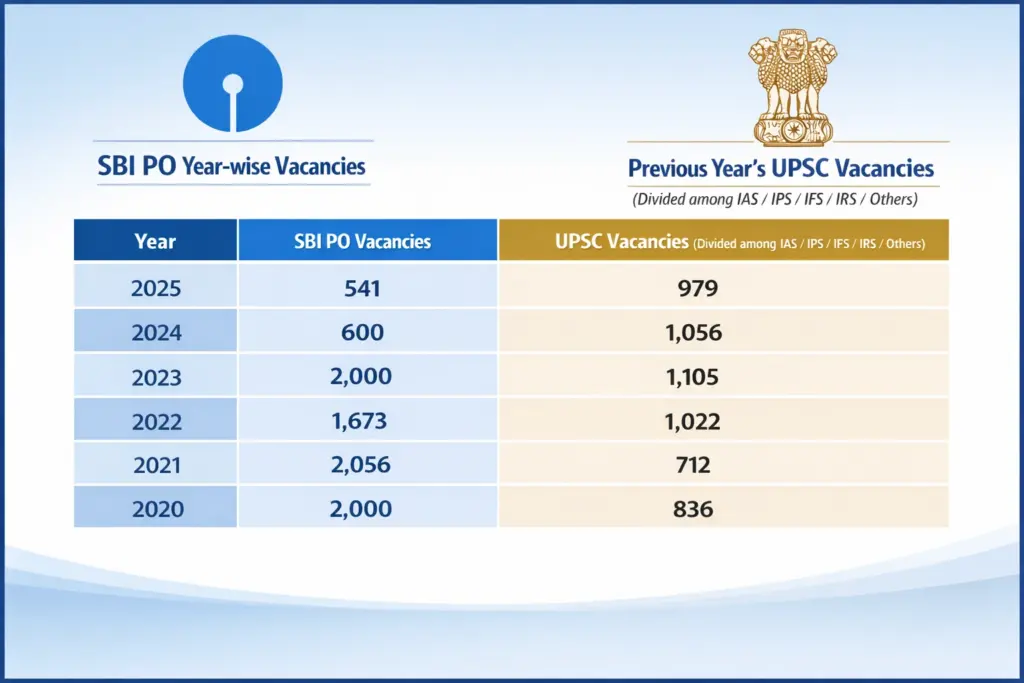
The UPSC Civil Services Exam is conducted once a year and offers a limited number of vacancies, usually around 900–1000 posts across all services. The entire selection process takes more than a year, and even a small mistake can push an aspirant back by another full year. Because of this, the level of uncertainty is very high.
The SBI PO exam, on the other hand, generally offers around 500–600 vacancies per notification. In some years, SBI conducts the exam more than once, which gives aspirants additional chances within the same year. The complete exam cycle is also much shorter, usually finishing within 6–8 months.
How many vacancies are there in SBI PO compared to UPSC?
In terms of competition, both exams are extremely competitive. UPSC sees around 10–15 lakh applicants, while SBI PO attracts 8+ lakh applications. However, SBI PO follows a more predictable pattern with a fixed syllabus and clearer selection stages. This makes planning and preparation slightly more controlled compared to the high uncertainty involved in UPSC.
In short, UPSC has fewer chances and higher uncertainty, while SBI PO offers comparatively better frequency and predictability, even though the competition remains tough in both exams.
What is the salary, career growth, and job profile of SBI PO?
An SBI PO earns around ₹75,000–₹85,000 per month as in-hand salary, depending on the posting location and allowances. Along with financial security, the role offers stability, social respect, and a clearly defined career path.
The initial years can be demanding, as the job involves responsibility and targets. However, career growth is structured and time-bound. With experience, officers move into higher managerial and executive roles. Over time, life becomes more predictable, and the constant uncertainty that many aspirants live with finally starts to ease.
Can SBI PO really be treated as a backup option?
This needs to be said very clearly. Approaching the SBI PO exam with a mindset of “let me just try” usually leads to failure. SBI PO is a highly competitive exam that requires full commitment, regular practice, mock tests, and focused preparation. UPSC aspirants who succeed in SBI PO are those who stop treating it as a backup option and start treating it as their primary goal. Half-hearted preparation does not work here—serious effort does.
Is SBI PO a good career option after failing UPSC?
For aspirants who have spent years preparing for UPSC, choosing SBI PO is not about settling for less but about choosing certainty and stability after prolonged uncertainty. SBI PO offers a respectable career, strong financial security, and a predictable exam cycle—provided it is approached with full commitment and seriousness.
| Factor | UPSC Civil Services | SBI PO |
| Exam Frequency | Once a year | Once or sometimes twice a year |
| Vacancies | ~900–1000 (all services) | ~500–600 per notification |
| Exam Duration | 1–2 years | 6–8 months |
| Nature of Exam | Vast, uncertain, descriptive | Limited syllabus, speed-based |
| Interview Focus | Personality & opinions | Job readiness & clarity |
| Entry-Level Pay | ₹56,100 basic (excluding allowances) | ₹75,000–₹85,000 in-hand |
| Preparation Approach | Long-term, high risk | Focused, high intensity |
| Suitability After UPSC | Emotionally draining if repeated | Stable and predictable option |
Frequently Asked Questions
Q1: Is SBI PO a good option for someone who has exhausted UPSC attempts?
A1: Yes, SBI PO can be a very sensible option after exhausting UPSC attempts. It offers stability, respect, good pay, and a structured career. However, it should be chosen seriously, not emotionally or casually.
Q2: Is SBI PO easier than UPSC?
A2: No. SBI PO is not easier—just different. UPSC is difficult because of its vast syllabus and uncertainty, while SBI PO is difficult because of speed, accuracy, and intense competition. Both require serious preparation.
Q3: Do gap years affect selection in SBI PO?
A3: Gap years are not an automatic disadvantage in SBI PO. What matters more is how clearly and confidently you explain your journey, your motivation, and your readiness for the role during the interview.
Q4: Can UPSC preparation help in clearing SBI PO?
A4: Yes, especially in General Awareness, Economy, Current Affairs, and Descriptive English. However, UPSC aspirants must separately work on speed, quant, reasoning, and mock practice to succeed in SBI PO.
Q5: How many candidates apply for SBI PO compared to UPSC?
A5: UPSC usually sees around 10–15 lakh applicants, while SBI PO attracts around 8–10 lakh applicants. Both exams are highly competitive, but SBI PO follows a more predictable pattern.
Q6: Is SBI PO suitable as a Plan B while preparing for UPSC?
A6: SBI PO should not be treated as a casual Plan B. It is a tough exam that demands full commitment. Aspirants who succeed are those who prepare for SBI PO as their primary goal, not as a side option.
Q7: How long does the SBI PO exam process take?
A7: The SBI PO exam cycle usually gets completed within 6–8 months, which is much shorter compared to the UPSC exam cycle.
- Is SBI PO a Good Option after UPSC? Compare Stages, Salary, and Vacancy
- SBI PO vs. SSC CGL: Which is a better career option?
- SBI PO Mains & Final Score Card 2025 Out, Check Mains and Interview Marks
- 7 Big Advantages of Becoming an SBI PO in 2026
- State Bank of India Careers, SBI PO, and SBI Clerk Promotions
- SBI PO Interview Date 2025 Out, Also Check Psychometric Test and GD Dates

Hi, I’m Tripti, a senior content writer at Oliveboard, where I manage blog content along with community engagement across platforms like Telegram and WhatsApp. With 3+ years of experience in content and SEO optimization related to banking exams, I have led content for popular exams like SSC, banking, railways, and state exams.