
Key Takeaways
- Average Questions are crucial in competitive exams like SSC and Banking, testing skills in arithmetic and logical distribution.
- Different types of Average Questions include direct, puzzle-based, application-based, and mixed-concept problems.
- Quick calculation skills and logical substitution are essential for solving Average Questions efficiently.
- Understanding common mistakes, such as misapplying formulas and rounding too early, can help you avoid pitfalls during exams.
- Using tricks like the middle term rule for consecutive numbers can speed up solving Average Questions.
The topic Average is one of the most basic yet highly scoring chapters in Quantitative Aptitude. Whether you are preparing for SSC, Banking, RRB, or State-level exams, you will definitely face 1–2 questions on averages. In this blog, we have provided all the details about the importance of average, types of questions asked, short notes, formulas, Solved questions from 2026 exams, and more.
Attempt Live Quiz on Average Questions
Attempt them live and check your score according to the real exam marking scheme.
What is Average in Quantitative Aptitude?
In Quantitative Aptitude, Average represents the central value of a group of numbers. It is calculated by dividing the sum of values by the number of values.

Why it appears in exams?
- It checks a candidate’s ability to deal with arithmetic, ratios, and logical distribution.
- Average-based questions often link with other topics like speed, time, age, and mixture.
Skills required to solve quickly:
- Quick calculation skills
- Logical substitution
- Pattern recognition
Why is Average important in Competitive Exams?
Average is a repeat-topic in almost all competitive exams. It looks simple but examiners often mix it with other chapters to increase difficulty.
| Exam | No. of Questions | Difficulty |
| SSC CGL / SSC CHSL | 1–2 | Easy |
| IBPS PO / SBI PO | 1–2 | Moderate |
| RRB NTPC / RRB Group D | 1 | Easy |
| State PSC / Police | 1–2 | Moderate |
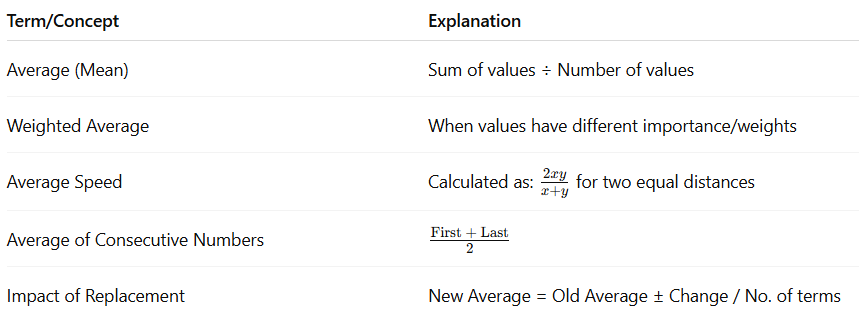
Average Quantitative Aptitude Short Notes
Here’s a quick summary of must-know concepts related to Averages:
Quick Revision Summary
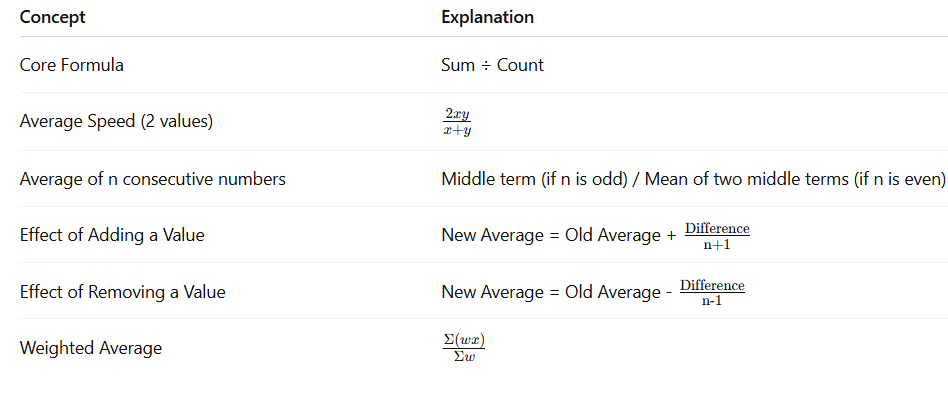
Some quick revision summary notes for final preparation before the exam are as follows:
What are the types of Average Questions in Quantitative Aptitude?
In exams, average-based questions can appear in different forms:
- Direct: Simple average of given numbers
- Puzzle-based: Average of groups with missing terms
- Application-based: Averages in ages, cricket scores, or salaries
- Mixed-concept: Average with speed, time, mixture, or percentages
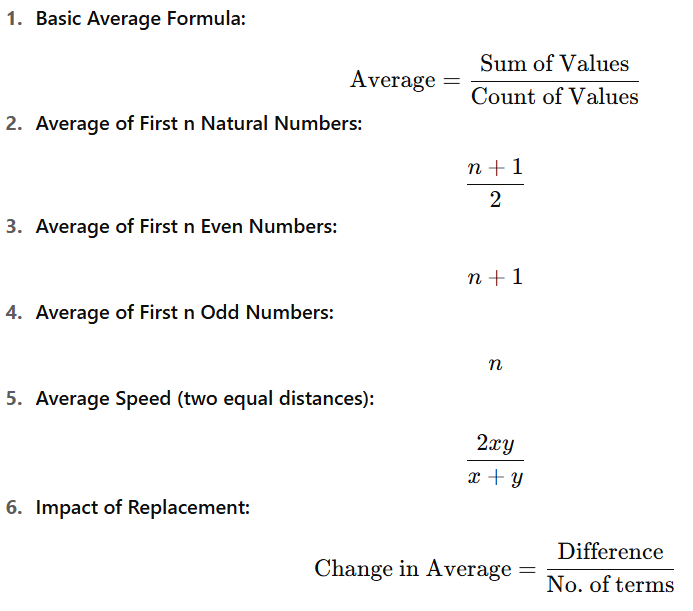
Average Formulas for Quantitative Aptitude
To save time, remember these formulas:
Average Tricks for SSC CGL and Other Exams
To solve questions faster:
- Avoid writing full steps – use mental math.
- For consecutive numbers, average = middle term.
- In cricket score problems, use difference rule instead of recalculating.
- For weighted averages, use alligation method.
- When speed is involved, check if distance is equal – apply harmonic mean formula.
Practice Average Questions Live
These questions on average are specially prepared for competitve exams. Solving these will help you strengthen your concept of averages and improve your preparation for upcoming exams.
1. The average of 11 consecutive integers is 45. If the smallest and largest numbers are removed, what is the average of the remaining numbers?
2. The average of 15 numbers is 62. The average of the first 8 numbers is 55 and that of the last 8 numbers is 70. Find the 8th number.
3. The average of 24 observations is 72. Later it was found that one value 96 was wrongly recorded instead of 69 and another value 45 was omitted. What is the correct average?
4. The average of 9 consecutive even numbers is 74. If 4 is added to each number, what will be the new average?
5. The average age of 30 employees is 35 years. 5 employees leave whose average age is 42 years. What is the average age of the remaining employees?
6. A batsman has an average of 52 runs after 25 innings. In the next innings he scores 128 runs. What must be his average in the next 4 innings to make his overall average 60 after 30 innings?
7. The average of 12 numbers is 36. If each number is multiplied by 1.5, and then 6 is subtracted from each, what is the new average?
8. The average of 5 consecutive multiples of 7 is 84. What is the largest number?
9. The average of 18 numbers is 72. If 6 numbers whose average is 65 are replaced by 6 new numbers whose average is 80, what is the new average?
10. The average salary of 40 workers is ₹32,500. The average salary of 25 workers is ₹28,000. What is the average salary of the remaining workers?
11. The average of 6 numbers is 25. If one number is excluded, the average becomes 23. What is the excluded number?
12. The average of 5 consecutive odd numbers is 64. What is the product of the smallest and largest numbers?
13. The average of 10 numbers is 64. If 3 numbers whose average is 70 are removed and 3 new numbers whose average is 50 are added, what is the new average?
14. The average marks of 100 students is 55. The average of boys is 60 and that of girls is 50. If the number of boys is 40, what is the number of girls?
15. The average of 7 numbers is 30. If each number is increased by 20%, what is the increase in the average?
16. The average speed for 4 equal distances at speeds of 30 km/h, 45 km/h, 60 km/h, and 90 km/h is:
17. The average of 25 observations is 78. If each observation is divided by 3 and then 4 is added to each, what is the new average?
18. The average of 8 numbers is 90. If one number is 150, what must be the average of the remaining numbers?
19. The average income of A, B, C, and D is ₹45,000. The average income of A and B is ₹50,000 and that of C and D is ₹40,000. What is the difference between the total income of (A + B) and (C + D)?
20. The average of 16 numbers is 75. If 4 numbers whose average is 60 are removed, what is the average of the remaining numbers?
21. The average of first n natural numbers is 21. Find n.
22. The average of 14 consecutive integers is 205. What is the sum of the smallest five integers?
23. A student’s average in 6 tests is 72. If he scores 90 in the next test, what must be his average in the last 3 tests to make his overall average 80 in 10 tests?
24. The average of 12 numbers is 50. If two numbers 30 and 70 are replaced by 90 and 10 respectively, what is the new average?
25. The average of 9 numbers is 81. If one number is increased by 27, how much will the average increase?
26. The average of 5 consecutive multiples of 9 is 117. What is the smallest number?
27. The average weight of 24 persons increases by 1.8 kg when a new person joins the group. How much heavier is the new person compared to the previous average?
28. The average of 7 numbers is 63. If each number is replaced by its square, which of the following must be true?
29. The average of 4 numbers is 25. If their ratio is 1:2:3:4, what is the largest number?
30. The average of 30 numbers is 18. If 5 numbers whose average is 12 are removed and 5 new numbers whose average is 30 are added, what is the new average?
Quiz Summary

Sign Up
Or, register with email
 Email Id
 Mobile Number
 Password

Login
Email Id
Password
Forgot Password
Please enter the Email ID we will send you a Email with the link to reset the password.
Email Id
Or, login with

Common Mistakes to avoid while Solving Average Questions
Some of the common mistakes that aspirants must avoid while solving average questions are as follows:
- Forgetting number of terms – Always check count before dividing.
- Misapplying average speed formula – Works only when distance is equal.
- Mixing up weighted average and simple average – Identify correctly.
- Not updating total when adding/removing values – Recalculate sum properly.
- Rounding too early – Keep exact values until the final step.
FAQs
Use direct formulas like middle term rule or difference rule.
Yes, average forms the base of alligation method.
Yes, often in pie chart and table DI.
New average = Old average ± Difference ÷ No. of terms.
Average = (First + Last)/2.
- NABARD Grade A Practice Quiz, Download Free PDF
- IBPS SO IT Officer DBMS Quiz 2026, FREE PDF & Quiz
- IBPS SO IT Officer Networking Quiz 2026, FREE PDF & Live Quiz
- IBPS SO IT Officer Operating Systems Quiz 2026, FREE PDF & Live Quiz
- IBPS SO IT Officer Data Structures Quiz 2026, FREE PDF & Quiz
- IBPS SO IT Officer Software Engineering Quiz 2026, FREE PDF
Hi, I’m Aditi. I work as a Content Writer at Oliveboard, where I have been simplifying exam-related content for the past 4 years. I create clear and easy-to-understand guides for JAIIB, CAIIB, and UGC exams. My work includes breaking down notifications, admit cards, and exam updates, as well as preparing study plans and subject-wise strategies.
My goal is to support working professionals in managing their exam preparation alongside a full-time job and to help them achieve career growth.