
Key Takeaways
- Life after clearing SSC CGL brings job security, social respect, and financial stability, making it a popular choice among aspirants.
- Candidates receive various benefits, including competitive salaries, work-life balance, and government perks like transport allowances and medical facilities.
- Initial months involve training, with gradual increase in responsibilities, leading to a smoother transition into government roles.
- SSC CGL provides varied job profiles from desk-oriented positions to field duties, allowing flexibility based on personal preference.
- Clearing SSC CGL is considered life-changing, as it offers a structured career path and helps reduce the stress associated with job insecurity.
Life after clearing SSC CGL offers candidates an opportunity to build a stable career in the Central Government. The Staff Selection Commission Combined Graduate Level Examination recruits candidates for various Group B and Group C posts, including Assistant Section Officer, Income Tax Inspector, Auditor, Accountant and Tax Assistant. Selected candidates receive salaries and allowances according to their posts and pay levels. This article explains what to do after SSC CGL Tier 1, the selection and joining process, job responsibilities, salary benefits, lifestyle and career growth opportunities.
What is the Life after clearing SSC CGL?
Life after clearing SSC CGL depends on the post allotted to the candidate. Some jobs involve administrative and desk-based responsibilities, while others include inspections, field visits or operational duties. Candidates selected throughSSC CGL Exam can expect a structured work environment, regular income and opportunities for professional development.
However, qualifying Tier 1 alone does not guarantee a government job. Candidates must successfully complete the remaining stages of the selection process and fulfil the applicable eligibility and appointment requirements.
What happens after clearing the SSC CGL Exam?
After successfully completing the required examination stages, candidates proceed through the remaining recruitment and appointment formalities. Final selection depends on merit, eligibility, post preferences, vacancies and applicable recruitment rules.
| Stage | What Happens? |
|---|---|
| Final Result | SSC publishes the final selection or allocation details according to the applicable recruitment procedure. |
| Document Verification | Required educational, identity, category and other certificates are verified by the designated authority. |
| Post Allocation | Candidates are considered for posts based on merit, preferences, eligibility and vacancies. |
| Medical or Other Requirements | Applicable post-specific medical, physical or other requirements must be fulfilled. |
| Appointment and Joining | The recruiting department completes the necessary formalities and issues appointment instructions. |
| Training or Probation | Selected candidates undergo induction, training or probation wherever prescribed. |
The time between the final result and joining can vary depending on the department and completion of the required formalities.
What does life look like immediately after clearing SSC CGL?
Life after clearing SSC CGL changes quickly but not dramatically overnight. The first visible change is mental relief after years of preparation. Soon after result and allocation, candidates go through document verification and joining formalities. Initial months are spent in training or probation, where candidates learn departmental rules, office procedures, and basic administrative functioning. Salaries start coming in regularly, but responsibilities are limited in the beginning. The real workload gradually increases after confirmation, making the transition smooth rather than overwhelming.
What to do after SSC CGL Tier 1?
After appearing for the SSC CGL Tier 1 Exam, candidates should focus on preparing for Tier 2 rather than waiting for the result. Tier 2 plays an important role in determining final merit and post allocation. Candidates should also check the official SSC website regularly for answer keys, results and further recruitment updates. The table below highlights the important steps to follow after SSC CGL Tier 1.
| Steps | What Candidates Should Do |
|---|---|
| Check Answer Key | Download the provisional answer key and response sheet when released to estimate marks and raise objections, if required. |
| Check Tier 1 Result | Monitor the official SSC website for the Tier 1 result and qualifying status. |
| Start Tier 2 Preparation | Focus on Mathematical Abilities, Reasoning, English Language, General Awareness and Computer Knowledge. |
| Practise Previous Year Papers | Solve SSC CGL Tier 2 previous year question papers to understand the exam pattern and important topics. |
| Prepare for DEST | Practise the Data Entry Speed Test, which is part of the Tier 2 examination process. |
| Attempt Mock Tests | Take full-length Tier 2 mock tests regularly to improve accuracy, speed and time management. |
| Keep Documents Ready | Arrange educational certificates, identity proof and category certificates, wherever applicable, for subsequent recruitment stages. |
Candidates should use the time between Tier 1 and Tier 2 effectively by revising important topics, analysing their performance and practising questions regularly. Those who qualify for Tier 2 must follow the latest SSC instructions regarding the examination schedule and subsequent selection procedures.
Why is SSC CGL considered a life-changing exam by aspirants?
SSC CGL is considered life-changing because it converts uncertainty into stability. Many aspirants come from backgrounds where financial pressure, family responsibility, or job insecurity is high. Clearing SSC CGL offers a fixed income, government backing, and long-term security. It also removes the constant pressure of job hunting and frequent switching that many private-sector employees face. For many families, it represents generational upward mobility.
Which types of Job Profiles do candidates get through SSC CGL?
SSC CGL recruits candidates for both Group B and Group C posts across multiple ministries and departments. These include Income Tax Inspector, Central Excise Inspector, Assistant Section Officer, Auditor, Accountant, Tax Assistant, and Upper Division Clerk roles. Some posts are desk-oriented, while others involve field duties. The variety allows candidates to choose roles based on temperament, whether they prefer analytical desk work or field exposure.
How does daily work life differ across SSC CGL Posts?
Daily work life varies significantly by post and department. Desk posts like Auditor or ASO involve file work, drafting notes, data analysis, and coordination with other offices. Field posts like Income Tax Inspector involve surveys, inspections, and occasional travel. Some departments have fixed office hours, while others may require extended hours during audits, raids, or deadlines. This variation is important to understand because SSC CGL is not a single uniform job experience.
What are the advantages of working in the Government Sector through SSC CGL?
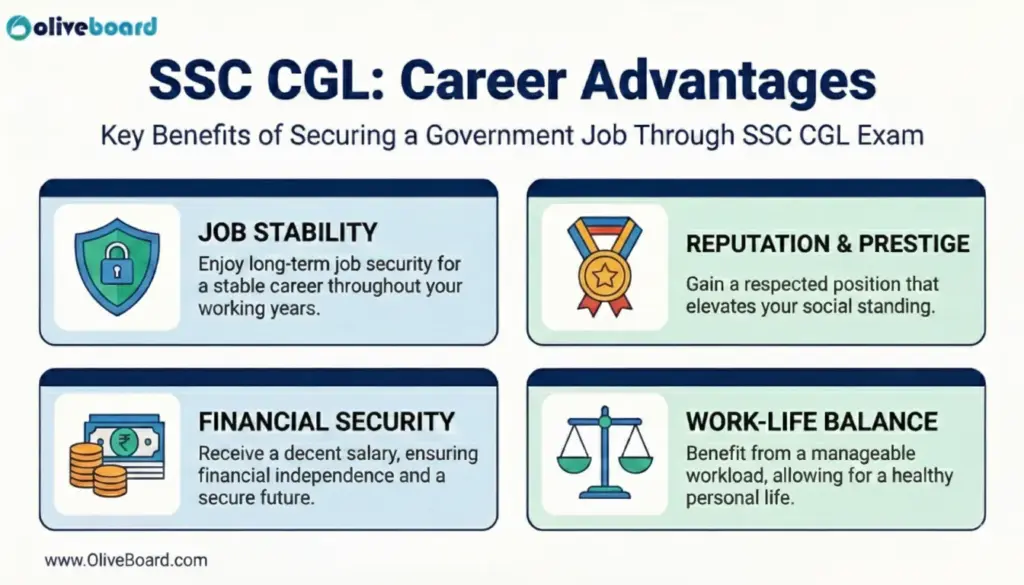
Clearing the SSC CGL exam brings several benefits that make a government job highly desirable:
- Job Stability: Government jobs provide long-term job security, ensuring employees have a stable career throughout their working years.
- Reputation: Government jobs carry a certain level of prestige and respect, elevating the social standing of the employees.
- Financial Security: SSC CGL positions come with a decent salary, ensuring financial independence and a secure future.
- Work-Life Balance: Most SSC CGL posts offer a manageable workload, allowing employees to maintain a healthy work-life balance.
Advantages of working in the government sector through SSC CGL with job security and stable career
What are the perks and benefits of SSC CGL?
- Transport Allowances: Employees receive transportation subsidies regardless of where they are posted.
- Gratuity Benefits: After completing five years of service, employees are eligible for gratuity, a lump sum amount paid by the government for their services.
- Leave Travel Concession (LTC): Employees can travel within India or abroad after a set period of service, providing a much-needed break.
- Medical Facilities: Government employees benefit from government medical schemes that cover their medical expenses.
- Paid Leave: Unlike many private-sector jobs, government jobs offer ample paid leave, ensuring employees can maintain a healthy balance between work and personal life.
SSC CGL Career Growth and Opportunities
Clearing the SSC CGL exam unlocks numerous career opportunities in various government sectors. Some of the most sought-after posts include:
- Income Tax Inspector: Responsible for assessing and collecting taxes. This role offers significant promotion opportunities, including Deputy Commissioner and Assistant Commissioner.
- Excise Inspector: Tasked with monitoring the production and distribution of goods and taxes associated with them. Promotions include roles like Appraiser and Superintendent.
- Tax Assistant: Responsible for preparing tax reports and assisting in tax-related tasks. This position offers opportunities for promotion to higher roles such as Deputy Commissioner.
Apart from these, candidates who clear the exam can work in departments like the Indian Revenue Service (IRS), Indian Economic Service (IES), and Indian Statistical Service (ISS). SSC CGL employees often receive promotions based on performance and seniority, opening avenues for career growth.
What are the challenges and rewards in SSC CGL?
While government jobs through SSC CGL offer numerous advantages, there are some challenges too. These include:
- Limited Autonomy: Government employees often work within strict rules and regulations, limiting their ability to take independent decisions.
- Resource Constraints: Working with limited resources and budgets can sometimes hinder employees’ ability to execute tasks efficiently.
- Political Interference: Some employees may experience pressure or interference from political factors affecting their day-to-day work.
However, the rewards far outweigh the challenges. Some of the most significant rewards include:
- Job Stability: Government jobs provide a high degree of security, which is invaluable in today’s uncertain job market.
- Good Benefits: Employees enjoy several benefits, including retirement plans, health insurance, and paid leave.
- Career Growth: There are numerous opportunities for advancement and promotion within the government sector.
- Job Satisfaction: Many employees find satisfaction in serving the public and contributing to society’s welfare.
FAQs
Ans. SSC CGL is a national-level exam in India conducted by the Staff Selection Commission (SSC) to recruit candidates for various Group B and Group C posts in the Government of India.
Ans. The SSC CGL exam can be tough, because of competition. But with proper preparation and hard work, it is possible to do well in the exam.
Ans. There are plenty of pros for SSC CGL as a career choice: good pay, job security, work-life balance, numerous allowances for travel, better medical and educational amenities, and housing facilities.
Ans. Strictly speaking, there are no cons to SSC CGL as a career path. However, this is different for different individuals. If one feels that slower progress in professional life, political and external pressure, and transfers every few years are aspects they do not want in their professional life, then other options may be better.
Ans. The time taken to become an SSC CGL officer varies from aspirant to aspirant. Some take 2 years while some may clear it in the first go. One thing is certain- SSC CGL is not difficult to clear with dedicated work and effort.
Ans. Candidates can register online for SSC CGL 2025 from the official website of the SSC.
SSC CGL jobs offer a stable income, job security, and a balanced lifestyle.
SSC CGL ensures financial stability, social prestige, and a secure career.
Government jobs provide structure, security, and benefits like medical coverage and paid leave.
Securing an SSC CGL job brings pride, stability, and a fulfilling career.
- SSC CGL Tier 2 Important Topics 2026–27, Check Subject-Wise List
- SSC CGL Tier 2 Paper 2 Study Plan for 30 days, Check the Details
- How to Prepare Statistics for SSC CGL Tier 2 2026? Check Here
- SSC CGL Marks Calculator, Get Tier 1 Scores Now
- SSC CGL Tier 2 Documents To Be Carried 2026, Check Details
- SSC CGL Tier 2 Paper 3 Study Plan 2026, 30-Day Finance and Economics Preparation Strategy

Hello, I’m Aditi, the creative mind behind the words at Oliveboard. As a content writer specializing in state-level exams, my mission is to unravel the complexities of exam information, ensuring aspiring candidates find clarity and confidence. Having walked the path of an aspirant myself, I bring a unique perspective to my work, crafting accessible content on Exam Notifications, Admit Cards, and Results.
At Oliveboard, I play a crucial role in empowering candidates throughout their exam journey. My dedication lies in making the seemingly daunting process not only understandable but also rewarding. Join me as I break down barriers in exam preparation, providing timely insights and valuable resources. Let’s navigate the path to success together, one well-informed step at a time.