

Failing a government job exam is painful. It hurts even more when the gap is just 0.25 to 2 marks. Months of preparation suddenly feel meaningless. Confidence drops. Self-doubt takes over.
But here is the truth. Failure in SSC, Banking, and State exams is common. With selection ratios close to 1%, these exams test patience, strategy, and decision-making as much as knowledge. Failure does not mean you are incapable. It simply means your approach needs correction.
This blog shares a practical recovery plan to help you restart preparation after failure emotionally, strategically, and academically.
What do candidates say about repeated exam failures?
Many aspirants clear government exams only after facing multiple setbacks. Repeated failure is not a sign of weakness; it is often a sign of scattered focus and wrong prioritisation.
One such experience, shared by an aspirant in a Reddit thread, highlights this clearly.
“I had a streak where I failed: SSC attempt One big bank mains by 2 marks A state level exam prelims For months I kept changing books, coaching, even cities. Nothing worked. Then I did something very boring. I picked one exam as “primary” and one as “secondary”. For me it became: Primary: SSC CGL Secondary: Bank PO and clerk What changed: Every day, first 2 hours were only for primary exam syllabus. Secondary exam content was fit into extra time or weekends. All mocks where I analysed properly were from primary exam pattern. Bank mocks were used as speed and pressure training. For mocks I stuck to oliveboard for SSC because their difficulty level kept me honest, and practicemock for bank speed drills. Did not go crazy comparing every platform or buying ten different series. Just these two, repeatedly. After one year of this, my marks did not explode but they became consistent. I started reaching the safe range in at least one side. The brain does not like ten targets. It likes one target with a clear backup.”
How to handle failure after failing SSC, Banking, or State exams?
The first step after failure is not rushing back to studies. Emotional stability is required before academic recovery. A calm mind helps you make better strategic decisions.
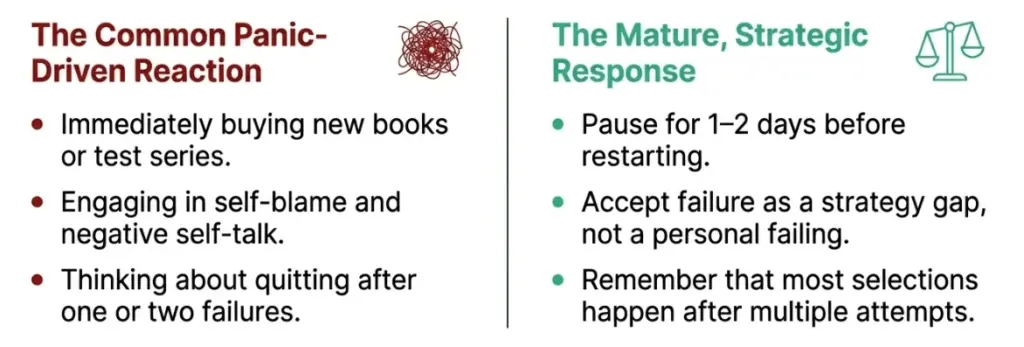
Handling failure maturely already puts you ahead of many aspirants.
How should you restart preparation after a setback?
Restarting preparation without analysis leads to repeated failure. Since most government exams do not release detailed answer keys, self-analysis becomes important.
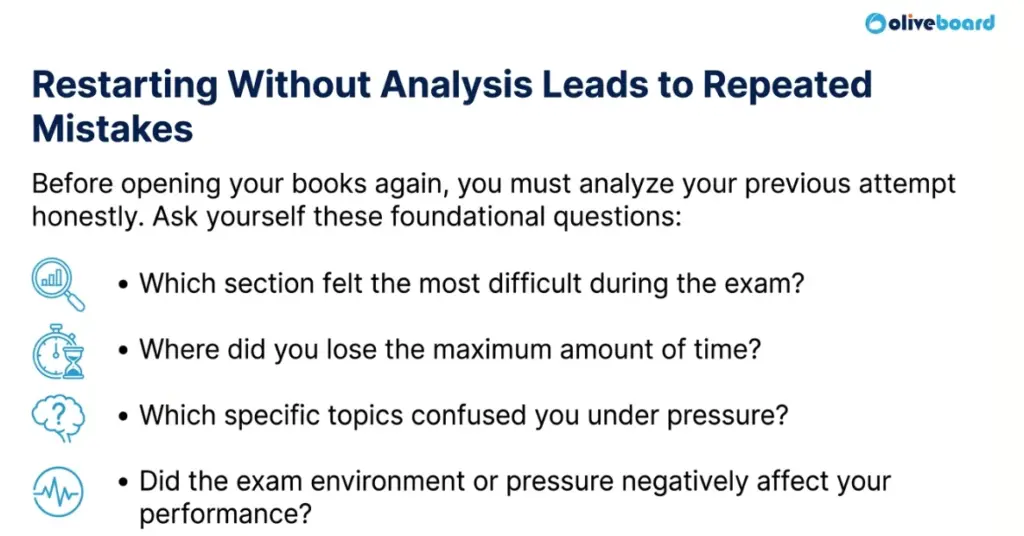
| Issues faced in the exam | What it indicates | How to resolve |
| One section felt extremely difficult | Weak concepts or poor practice | Revise the concepts regularly, practice more questions from that section, and solve previous year questions to build confidence. |
| Running out of time | Increase speed and try to select questions that are less time-consuming | Practice time-bound mock tests, develop a section-wise strategy, and prioritize easier questions first. |
| Blank moments under pressure | Exam temperament problems | Practice mindfulness and relaxation techniques, take regular mock tests to simulate exam pressure, and use positive self-talk during the exam. |
Example: If you attempted only 15 Quant questions instead of 22, it may indicate:
- Slow calculations
- Weak fundamentals
- Choosing lengthy questions that required more time
How to analyse your previous attempt properly?
Serious aspirants restart with data-backed analysis, not assumptions. This step decides whether your next attempt will improve or repeat the same mistakes.
1. Compare mock scores with actual exam performance
Many candidates perform well in mocks but underperform in the real exam. This gap reveals hidden issues.
- Were your mock scores consistently higher than your actual score?
- Did exam pressure reduce your speed or accuracy?
- Did you change your attempt strategy during the exam?
| Problems observed | Meaning | How to overcome |
| Mock scores higher than actual exam score | Your performance in practice tests is better than in the real exam | Treat mocks like actual exams, avoid distractions, and practice with strict timing. Review mistakes carefully and focus on weak areas. |
| Exam pressure or poor time management | Anxiety or running out of time affects performance | Practice time-bound tests regularly, develop a section-wise strategy, and use relaxation techniques (deep breathing, short mental breaks) to manage stress. |
| Strategy changed during exam | Deviating from your planned approach during the test | Stick to your pre-decided plan. Identify question types you will attempt first and follow your strategy consistently. |
| Lack of clarity and confidence | Feeling unsure about concepts or answers | Revise key concepts regularly, solve previous years’ questions, and take short confidence-building quizzes. Positive self-talk and structured preparation help. |
Example: If your mock average was 115–120 but actual score dropped to 105, the issue is not preparation level but pressure handling or time allocation.
2. Analyse accuracy vs number of attempts
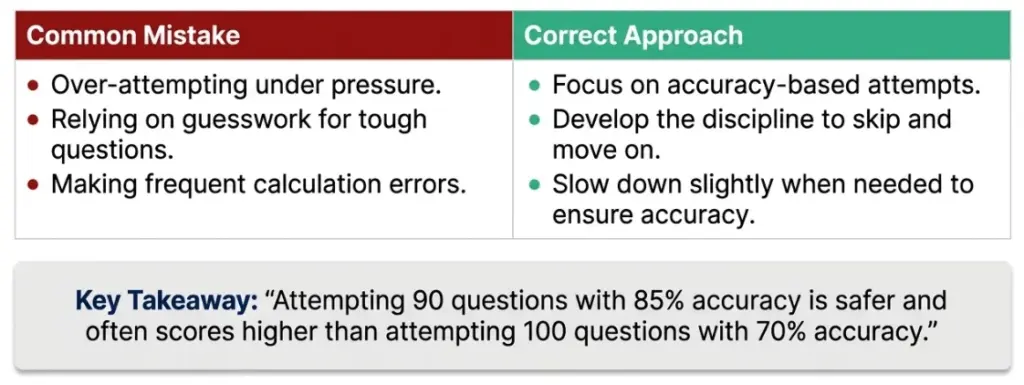
More attempts do not always mean more marks, especially in exams with negative marking. Attempting more questions does not always increase marks.
- Did you over-attempt under pressure?
- Were mistakes caused by guesswork or calculation errors?
- Did negative marking pull down your score?
3. Where marks are actually deducted?
Many aspirants believe they failed SSC, Banking, or State exams because they didn’t study enough or needed more books. In reality, most marks are lost inside the exam hall due to avoidable mistakes, not incomplete syllabus coverage.
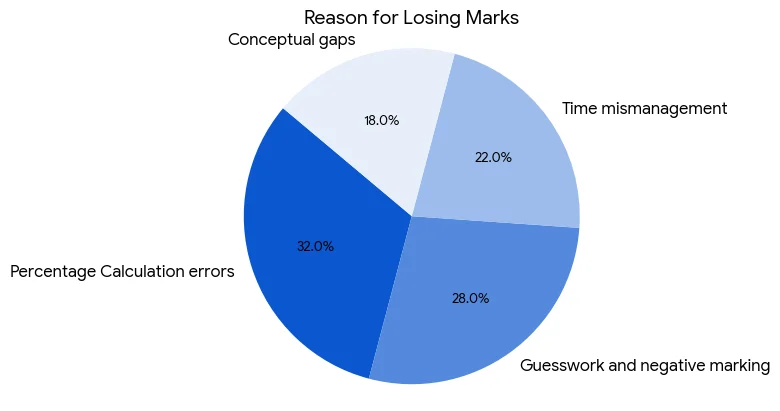
| Problem area | What goes wrong | How to resolve it |
| Calculation errors | Silly mistakes, panic, or rushing through easy questions | Slow down on simple questions, practice daily calculations, and double-check only high-accuracy questions in mocks. Accuracy > attempts. |
| Guesswork & negative marking | Blind attempts to increase attempts backfire | Set a strict guess limit. Attempt only when at least two options can be eliminated. Smart skipping saves more marks than random guessing. |
| Time mismanagement | Spending too long on a few questions | Follow a section-wise time cap, leave time-consuming questions early, and use mock tests to lock your exam order and pace. |
| Conceptual gaps | Weak fundamentals cause confusion | Identify weak topics through mock analysis, revise basics, and solve topic-wise questions instead of starting new books. |
4. Check sectional cut-off awareness
Many candidates fail despite a good overall score because they miss sectional cut-offs.
| Issue | What it shows | How to resolve |
| Missed one section by 1–2 marks | Imbalanced preparation | Allocate equal time to all sections during preparation, identify weaker areas, and practice questions from those sections regularly. |
| Too much time on strong section | Poor time distribution | Set time limits for each section in mocks, practice prioritizing questions, and stick to your planned exam strategy. |
Failure here is not total failure, it is a planning mistake.
How to rebuild weak sections without losing confidence?
Once weak areas are identified, improvement must be systematic and gradual, not rushed.
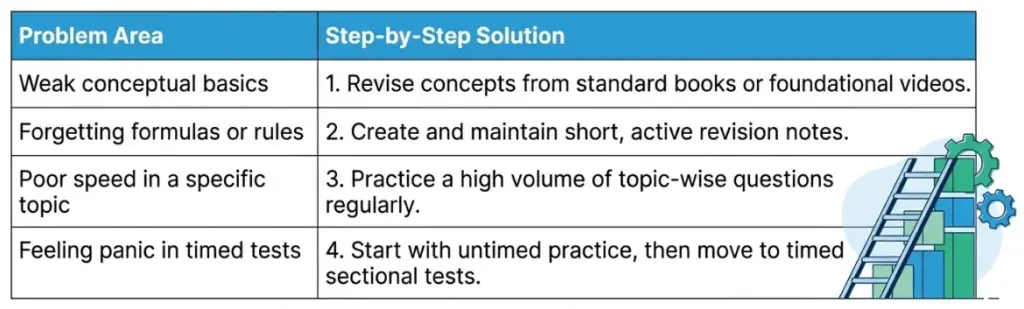
Example: If Arithmetic is weak:
- Start with Percentage, Ratio, and Simple Interest
- Practice easy questions first
- Gradually increase difficulty and speed
Weak sections can become scoring areas with consistency.
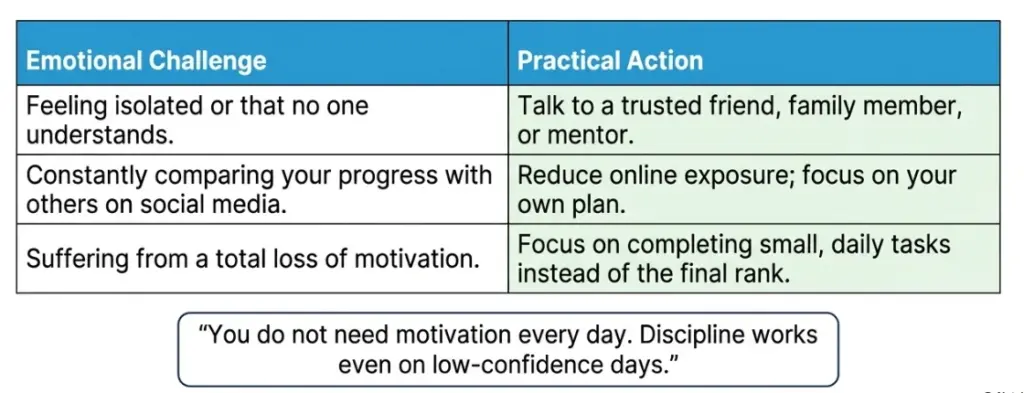
How can you recover emotionally after repeated exam failures?
Emotional recovery is as important as academic preparation. Ignoring mental health leads to burnout.
How can you avoid repeating the same mistakes in the next attempt?
Avoiding repetition requires written tracking and regular review.
| What to track | Why it matters |
| Questions you got wrong | Prevent repeating the same errors |
| Forgotten concepts | Strengthen weak areas |
| Time-consuming questions | Learn when to skip |
Example: If Reasoning puzzles consume too much time, practice them daily with a timer and set a strict skip limit during exams.
Selection in SSC, Banking, and State exams depends not just on hard work, but on calm analysis, smart strategy, and disciplined execution. Failure is not the end, it is feedback. Use it wisely.
FAQs
No, failure usually indicates a strategy or execution gap, not a lack of ability.
Very common, as selection ratios are close to 1% and most candidates clear after multiple attempts.
No, taking time to regain emotional stability helps you restart with a clearer and smarter plan.
No, most marks are lost due to mistakes and poor attempts, not lack of syllabus coverage.
Calculation errors, guesswork, and time mismanagement cause more damage than conceptual gaps.
- OICL AO Mains Exam Analysis 2026, 28th February
- RRB NTPC Train Clerk Job Profile and Salary, Check Details
- SBI Clerk Mains Answer Key 2026 Response Sheet Date
- SEBI and Its Functions, Short Notes for JAIIB 2026
- SEBI IT Officer Syllabus 2026, Exam Pattern, Download PDF
- SEBI Law Officer Recruitment 2026, Download Notification PDF

Hi, I’m Aditi. I work as a Content Writer at Oliveboard, where I have been simplifying exam-related content for the past 4 years. I create clear and easy-to-understand guides for JAIIB, CAIIB, and UGC exams. My work includes breaking down notifications, admit cards, and exam updates, as well as preparing study plans and subject-wise strategies.
My goal is to support working professionals in managing their exam preparation alongside a full-time job and to help them achieve career growth.