

The RRB ALP CBAT 2026 is the final and most crucial stage for candidates aspiring to become Assistant Loco Pilots in Indian Railways. While the earlier stages (CBT-1 and CBT-2) test your academic ability, CBAT evaluates your aptitudes that directly relate to the job’s demands. Aiming to qualify for this exam requires precision, strategy, realistic self-assessment, and focused preparation. This article covers everything you need – from understanding the pattern to advanced preparation strategies that go beyond surface-level advice.
What is the RRB ALP CBAT 2026?
The RRB ALP CBAT (Computer-Based Aptitude Test) is designed to assess the cognitive abilities required for locomotive operation – visual coordination, spatial reasoning, concentration, response time, and pattern recognition. Unlike standard MCQ exams, this test measures your aptitude, a critical fit for job requirements. Candidates who clear CBT-1 and CBT-2 (with qualifying criteria set by the Railway Recruitment Board in 2026) are called for CBAT.
What is the exam pattern for RRB ALP CBAT 2026?
The RRB ALP exam pattern for CBAT is divided into sections like – Memory Test, Visual Comparison, Spatial Visualisation, Perceptual Speed, Concentration Test, Control Precision, and more. Check out the details given below:
| Section | Number of Questions | Skill Tested | Time Allotted | Scoring |
| Memory Test | 2 sets of 16 | Short-term visual memory | 90 seconds each | Adaptive |
| Visual Comparison | 16 | Speed & accuracy | 60 seconds | Negative marking |
| Spatial Visualization | 10 | Visualization ability | 90 seconds | Adaptive |
| Perceptual Speed | 1 set of 50 | Rapid identification | 70 seconds | High pressure |
| Concentration Test | 1 set of 60 | Sustained focus | 90 seconds | Negative marking |
| Control Precision | 16 | Fine motor coordination | 45 seconds | Time-bound |
What skills must you master for RRB ALP CBAT 2026?
Candidates must master skills like memory power, improve concentration levels, and more for the CBAT examination 2026. Given below are the section-wise details for the applicants:
1. Memory Test
This evaluates your ability to remember and recall visual information. You see shapes or symbols for a short time – then answer questions on them.
| Category | Key Tips |
| Preparation Tips | Practice sequence memory cards, grid patterns, and mirror patterns |
| Use timed apps that challenge short-term recall | |
| Focus on chunking (grouping items to remember more efficiently) | |
| Skills Built | Visual retention |
| Instant recognition | |
| Short-term memory organization |
2. Visual Comparison Test
In this test, candidates are required to compare two figures and decide if they are the same or different. Some of the details are as follows:
- Train with pairs puzzles under a ticking clock.
- Learn to scan from top-to-bottom & left-to-right systematically.
- Avoid randomness – use a methodical scan pattern.
3. Spatial Visualisation
This measures the ability to mentally rotate objects and visualise transformations. The practice methods include:
- Mental rotation puzzles
- 3D figure matching
- Geometric transformation drills
4. Perceptual Speed Test
This test evaluates a candidate’s speed and judgment under pressure. The correct approach should be:
- Solve multiple comparison sets rapidly.
- You must minimise hesitation – delay kills accuracy.
5. Concentration Test
This test demands sustained focus on a pattern, ignoring distractions. The exercises that help include:
- Letter and number cancellation practice
- Continuous performance tasks (CPT)
- Meditation & focus drills
6. Control Precision
In this test, the hand-eye coordination matters. A candidate’s precise cursor control is tested under time pressure.
- Practice using a mouse with precision drills
- Avoid laptop trackpads – a regular mouse gives an edge
- Try fine cursor tracing tasks
Advanced Preparation Strategy for RRB ALP CBAT 2026
Getting above-average scores requires structured practice, not just random drills. Check out the different strategies below:
Strategy 1 – Micro Modules
Break practice into 10-minute focused bursts. Check out the table below:
| Time | Activity |
| 10 mins | Memory drills |
| 10 mins | Visual scanning |
| 10 mins | Spatial tasks |
| 10 mins | Speed test |
| 10 mins | Focus challenge |
| 10 mins | Precision play |
Strategy 2 – Track and Analyse Your Performance
It is recommended to use a tracker to analyse your performance. The table below shows the details:
| Parameter | Your Goal | Your Current | Target |
| Accuracy (%) | ≥ 95% | – | 95–100 |
| Avg Response Time (sec) | ≤ 3 | – | 2–3 |
| Error Type (Memory) | Minimal | – | < 3 per set |
| Error Type (Speed) | Minimal | – | < 5 per 50 |
Strategy 3 – Adaptive Skill Training
Given below is a table showing the major points that candidates must focus on for adaptive skill training, simulator practice importance, and its features:
| Area | Key Focus Points |
| Adaptive Skill Training | Time-constrained practice |
| High speed with minimal errors | |
| Real CBAT interface simulations | |
| Stress tolerance drills | |
| Simulator Practice Importance | Mobile PDFs are ineffective for CBAT preparation |
| Essential Simulator Features | Real CBAT-style software |
| Reaction time measurement | |
| Precise and accurate timing | |
| Real, performance-based feedback |
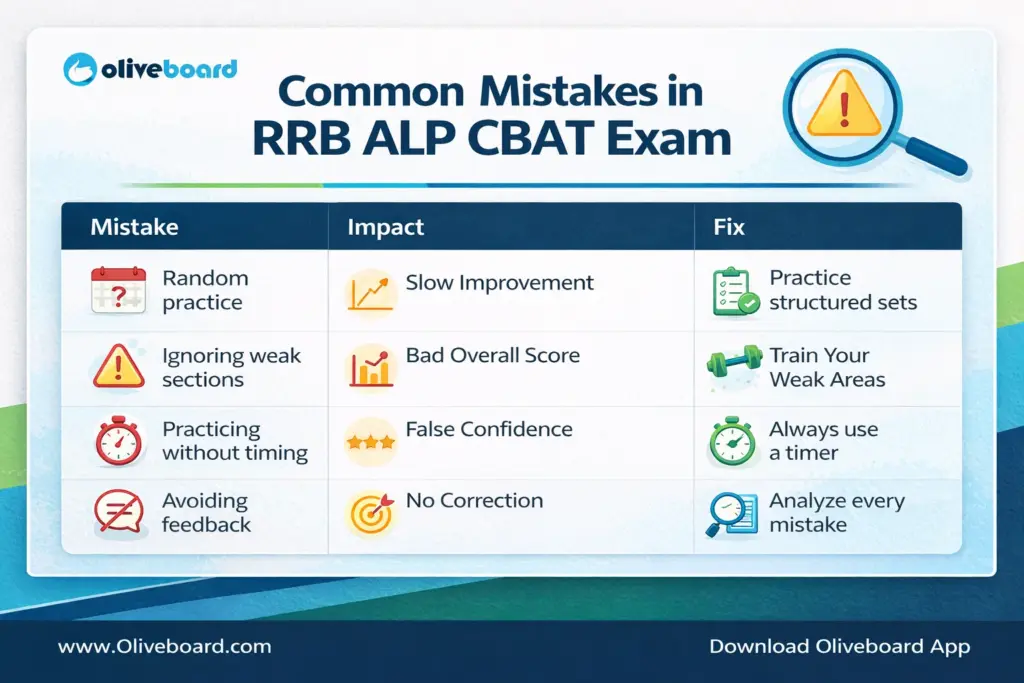
What are the common mistakes for RRB ALP CBAT 2026?
Common mistakes for RRB ALP CBAT 2026 include ignoring weak areas, avoiding feedback, and others. Given below are the details:
Final checklist for RRB ALP CBAT 2026
A final checklist for all RRB ALP exam aspirants appearing in the CBAT 2026 is provided below. Check them out:
- Understand each section’s logic
- Time yourself in every practice
- Analyze your errors
- Build strengths systematically
- Simulate a real CBAT environment
- Stay physically and mentally fit
FAQs
Yes, the RRB ALP CBAT 2026 follows a section-wise qualifying approach, not just an overall score. Candidates are required to score a minimum qualifying standard in each aptitude test. Even if your overall performance is strong, failing to meet the benchmark in any one test can lead to disqualification.
The final merit list for RRB ALP CBAT 2026 is prepared by combining CBT-2 and CBAT scores, usually in a fixed ratio decided by the Railway Recruitment Board. CBAT is not merely qualifying – it carries significant weightage.
Technically yes, but practically it is very risky. CBAT is designed around reaction time, cursor control, and adaptive difficulty, which cannot be replicated through books or mobile practice alone.
For an average candidate:
2–3 months of focused, daily aptitude practice is sufficient
Candidates with strong visual and coordination skills may need less time
Those struggling with speed or precision may require 3–4 months
The most common reason is underestimating CBAT. Many candidates assume it is easy because it doesn’t involve syllabus-based questions. In reality, CBAT tests natural aptitude under pressure. Lack of:
Timed practice
Error analysis
Real interface exposure
Mental conditioning

Hello! This is Arijit Dutta. I am a skilled Content Writer at Oliveboard with nearly 3+ years of experience in crafting engaging, informative, and exam-focused content for the Railways Domain. With a strong command of language and a keen understanding of learner needs, I contribute significantly to Oliveboard’s mission of delivering high-quality educational resources. Passionate about clear communication and continuous learning, I consistently create content that helps government job aspirants achieve their goals. Outside of work, I enjoy playing cricket and listening to music, which helps me stay balanced and creative in my professional journey.