

The NABARD Grade A exam is one of the most anticipated exams for candidates aspiring to work in the agriculture and rural development sectors of India. This blog provides a detailed NABARD Grade A exam analysis for the years 2023, 2024, 2025, and 2026, covering various aspects such as difficulty level, good attempts, and a section-wise breakdown.
NABARD Grade A Phase 2 Exam Analysis 2025
The NABARD Grade A Phase 2 exam was conducted on 25th January 2026. Aspirants who have cleared the Phase 1 exam appeared for this exam. We have provided the analysis based on the reviews shared by aspirants who have appeared for the Phase 2 exam.
NABARD Grade A 2026 Phase 2 Exam Analysis
The NABARD Grade A Phase 2 Exam 2025-26 was balanced and syllabus-focused, with a strong connection to agriculture, rural development, government schemes, and economic issues. Based on the feedbacks from the candidates, we have updated the table below with the section-wise difficulty levels.
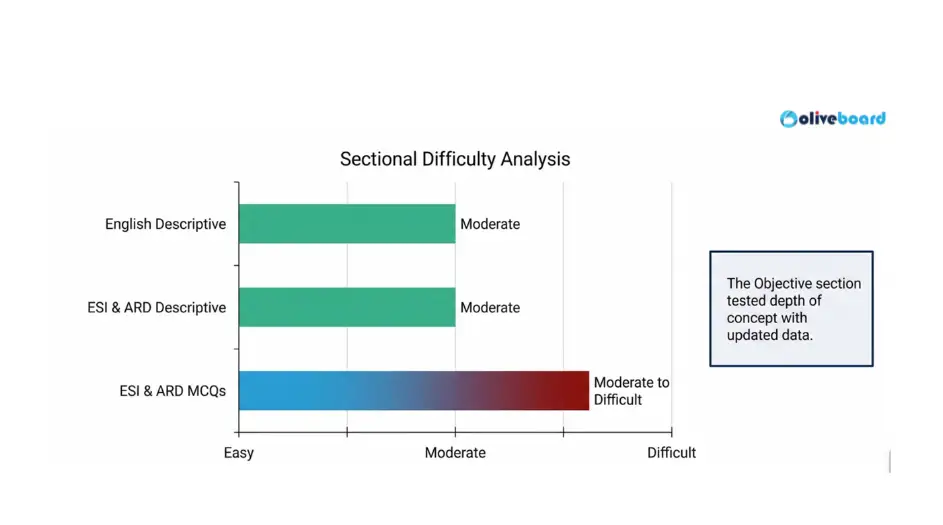
| Section | Level |
| English Descriptive | Moderate |
| ESI & ARD Descriptive | Moderate |
| ESI & ARD MCQs | Moderate to Difficult |
| Overall Paper | Moderate |
Also Check: NABARD Grade A Phase 2 Information Handout
What type of questions were there in the English descriptive paper?
The English Descriptive paper was scoring and analytical, focusing on current issues linked with agriculture, rural economy, social development, and technology. Below is a section-wise breakdown of the questions for better clarity and analysis.
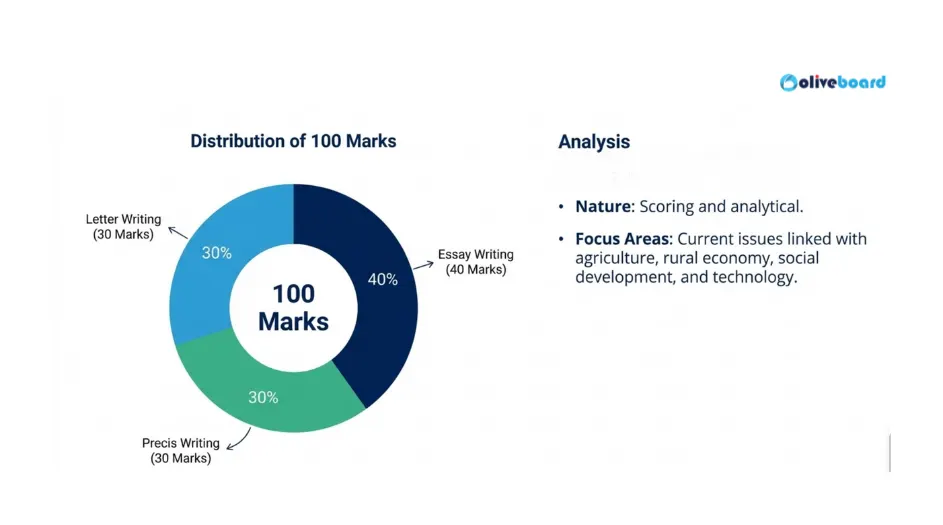
| Component | Marks | Status |
| Essay (1 out of 4) | 40 | Moderate |
| Precis Writing | 30 | Moderate |
| Letter Writing | 30 | Moderate |
| Total | 100 | Moderate |
The detailed section-wise overview of the topics covered in the exam:
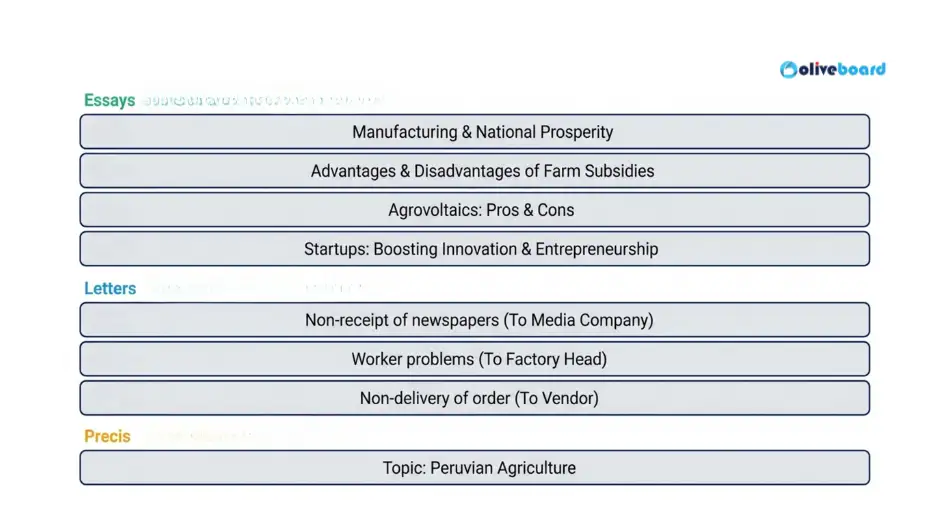
| Section | Topics |
| Essay | Manufacturing is important for the nation’s prosperity |
| Essay | Advantages & Disadvantages of Farm Subsidies in India |
| Essay | Advantages & Disadvantages of Agrovoltaics |
| Essay | How can a startup boost innovation & entrepreneurship |
| Letter | Letter to a media company regarding non-receipt of newspapers |
| Letter | Letter to the Head of the Factory addressing problems faced by workers |
| Letter | Letter to a vendor for non-delivery of order (as an employee of General Administration Department) |
| Precis Writing | Precis on “Peruvian Agriculture” |
What topics were asked in the ESI and ARD descriptive papers?
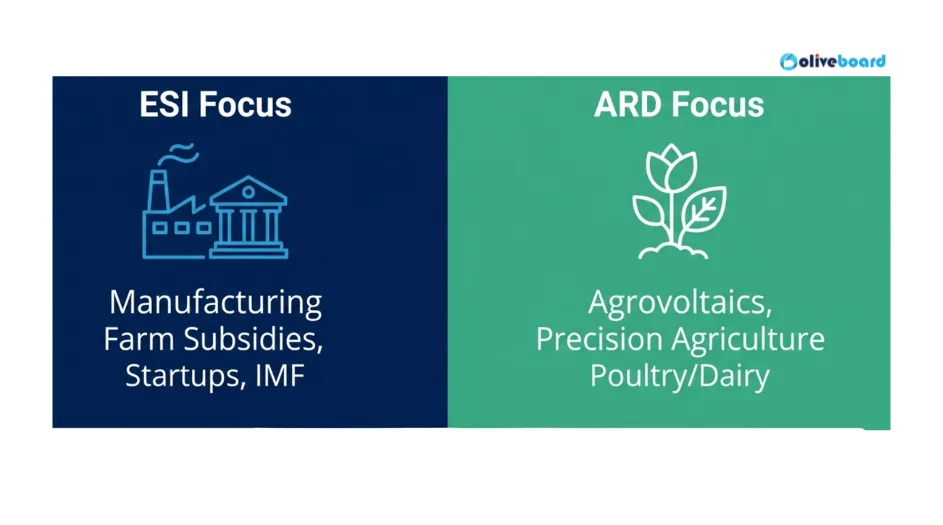
The ESI & ARD Descriptive section was direct, syllabus-aligned, and policy-driven. Questions were framed around manufacturing, farm subsidies, and startups, while ARD focused on farm subsidies, agrovoltaics, and agriculture-based precise topics. The topic-wise details are update below based on the feedback shared by the aspirants.
| Paper | Descriptive topics asked |
| ARD | Challenges faced by the Indian Poultry Sector |
| ARD | Challenges faced by the Indian Dairy Sector |
| ARD | How Dairy & Poultry sectors complement and supplement agriculture |
| ARD | Integrated Farming System and multiple income sources |
| ARD | Digital Agriculture Mission – objectives, components, and benefits |
| ARD | Precision Agriculture technologies (remote sensing, VRT, site-specific farming) |
| ESI | Tariffs & Protectionism – positive and negative impact on the Indian economy (15 marks) |
| ESI | Labour Migration – meaning, challenges, opportunities, and government measures (10 marks) |
| ESI | Role of World Bank & IMF in globalization, reforms, and economic growth in India |
What topics were asked in the ESI and ARD objective paper?
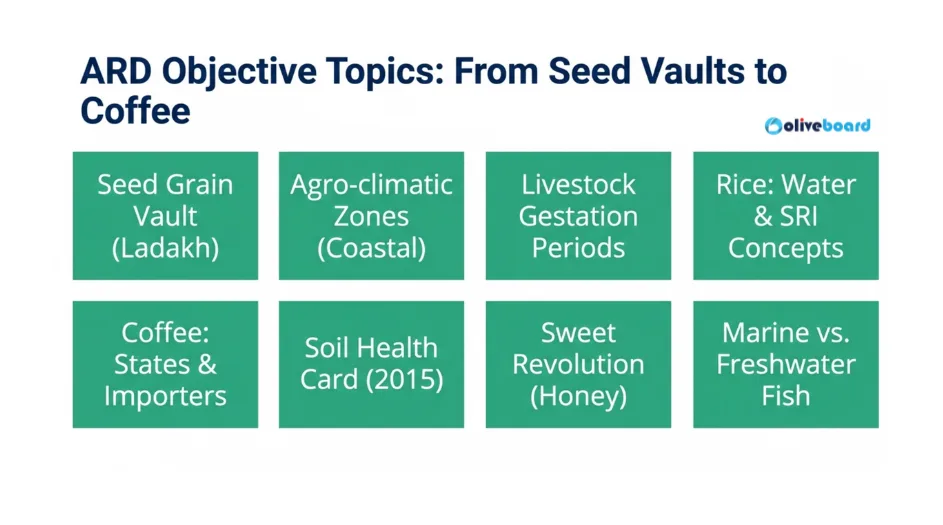
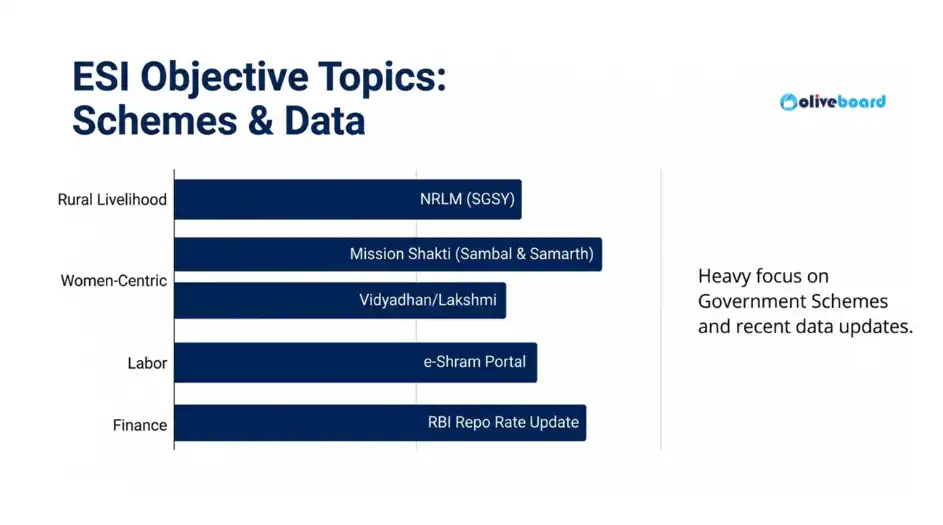
The MCQs were concept-based with updated data. It had strong current-affairs linkage, covering topics like Seed Grain Vault, agro-climatic zones, dairy/fishery basics, rice & SRI, coffee production and exports, Soil Health Card, Sweet Revolution, RBI repo rate, NRLM, Mission Shakti, e-Shram, and women-centric schemes, with a few paragraph-based questions. The topic-wise details are updated below based on the feedback shared by the aspirants.
| Paper | Objective topics asked |
| ARD | Seed Grain Vault – location (Ladakh), purpose, biodiversity protection |
| ARD | Coconut-based farming system and coastal/island agro-climatic zones |
| ARD | Agro-climatic zones of India (Eastern coastal, Western coastal, Islands) |
| ARD | Gestation period of major livestock animals |
| ARD | Identification of marine vs freshwater fish |
| ARD | Rice crop – water requirement at different growth stages |
| ARD | System of Rice Intensification (SRI) concepts |
| ARD | Coffee plantation – producing states after Karnataka |
| ARD | Major countries importing Indian coffee |
| ARD | Soil Health Card – launch year (2015) |
| ARD | Sweet/Golden Revolution (Honey) |
| ESI | RBI Repo Rate (recent update) |
| ESI | National Rural Livelihood Mission (NRLM) – earlier name (SGSY) |
| ESI | Mission Shakti – components (Sambal & Samarth) |
| ESI | e-Shram Portal |
| ESI | Women-centric schemes (Vidyadhan/Lakshmi, etc.) |
| Trend | High current-affairs linkage across objective questions |
NABARD Grade B Analysis, 25 January 2026, Video Analysis
A detailed video analysis of the NABARD Grade B Exam held on 25th January 2026 is shared below, covering both ESI and ARD papers. This video explains the question trends, topic-wise weightage, difficulty level, and key takeaways, helping aspirants clearly understand how the paper was framed and what to focus on for upcoming attempts.
Check out the detailed analysis of the NABARD Grade A ESI paper:
Check out the detailed analysis of the NABARD Grade A ARD paper:
NABARD Grade A Phase 1 Last 3 Years Analysis
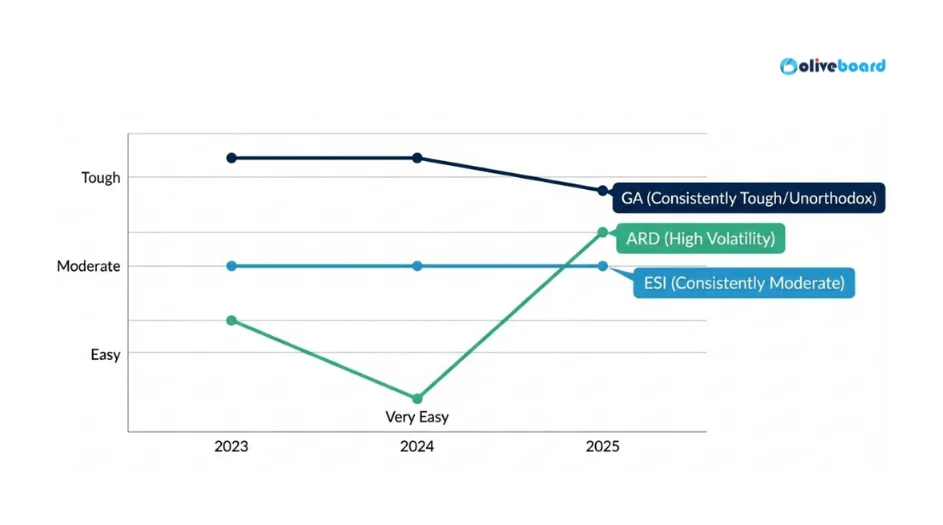
The details of the NABARD Grade A Merit section paper analysis are as follows:
NABARD Grade A Phase 1 Common Schemes
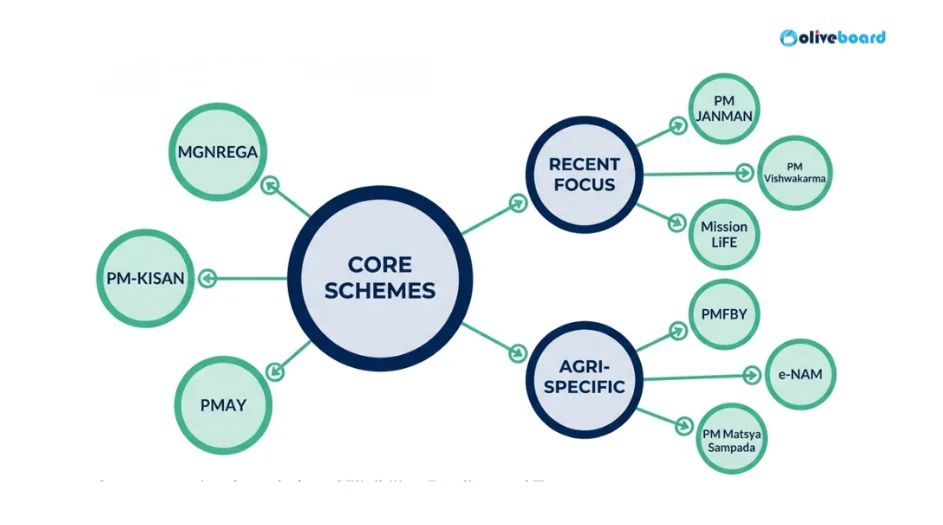
Common schemes from which questions were asked in the last 3 years are as follows:
NABARD Grade A 2025-26 Phase 1 Exam Analysis
The NABARD Grade A Prelims exam 2025 is scheduled to be held on 20th December 2025. As the exam concludes, candidates eagerly await the analysis to assess the difficulty level and evaluate their performance. According to aspirant feedback, the overall difficulty level of the NABARD Grade A Phase 1 exam was moderate.
This exam consists of various sections, including Reasoning, English Language, Computer Knowledge, Quantitative Aptitude, Decision Making, General Awareness, Economic & Social Issues, and Agriculture & Rural Development. In this section, we will analyze the exam conducted in both shifts, highlighting the key aspects of each section.
NABARD Grade A Exam Analysis – Difficulty Level
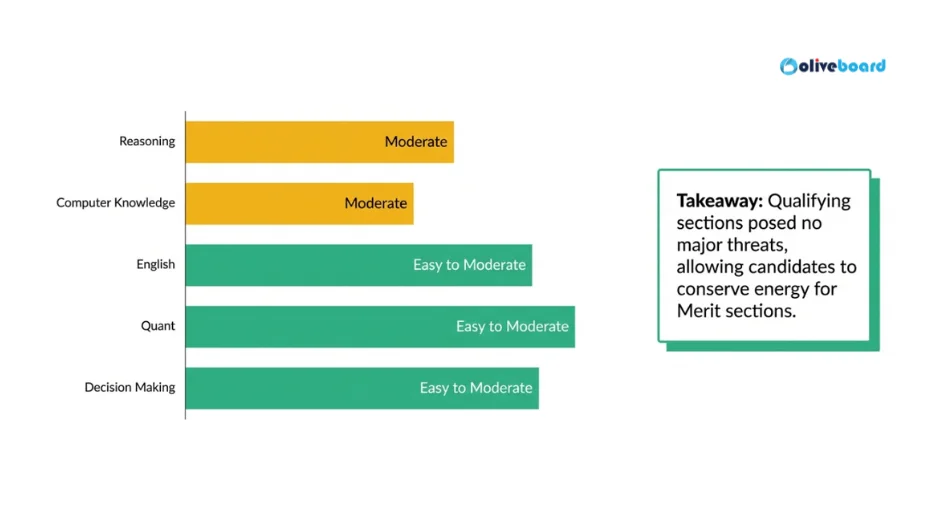
The difficulty level of the exam is a crucial factor that determines how well candidates can perform. Based on the insights gathered from the candidates, we have updated the table below with the section-wise difficulty levels. This will help in understanding which sections were more challenging and which were relatively easier.
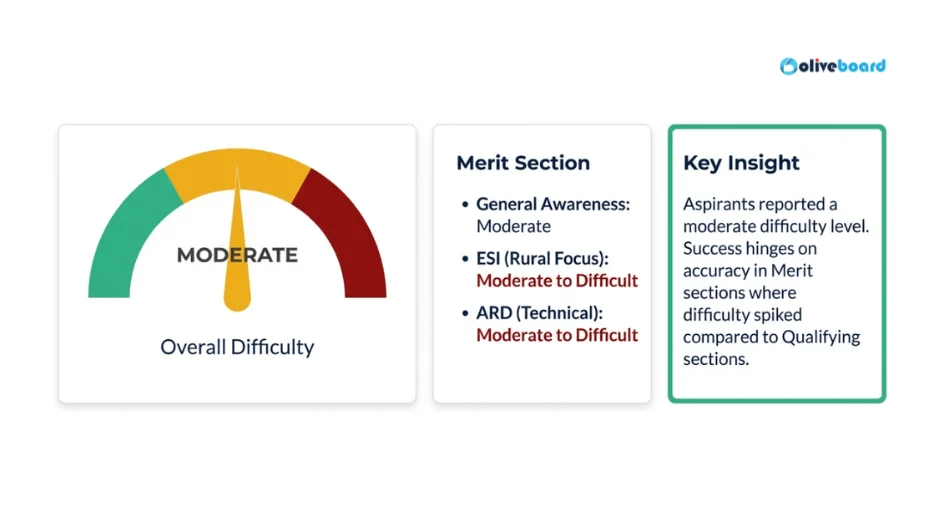
| Name of the Test | Difficulty Level |
| Test of Reasoning | Moderate |
| English Language | Easy to Moderate |
| Computer Knowledge | Moderate |
| Quantitative Aptitude | Easy to Moderate |
| Decision Making | Easy to Moderate |
| General Awareness | Moderate |
| Economic & Social Issues (with a focus on Rural India) | Moderate to Difficult |
| Agriculture & Rural Development (with emphasis on Rural India) | Moderate to Difficult |
| Overall | Moderate |
NABARD Grade A Exam Analysis – Good Attempts
Good attempts refer to the number of questions that candidates should ideally answer correctly to be in a safe position. While it’s essential to aim for high accuracy, good attempts provide a general benchmark to help candidates understand where they stand. However, it is important to note that good attempts may vary from the actual cutoff. We will update the table below with the good attempts for each section based on the feedback received.
| Name of the Test | Good Attempts |
| Test of Reasoning | 13 – 15 |
| English Language | 16 – 17 |
| Computer Knowledge | 15 – 16 |
| Quantitative Aptitude | 12 – 14 |
| Decision Making | 6 – 7 |
| General Awareness | 14 – 16 |
| Economic & Social Issues (with a focus on Rural India) | 22 – 25 |
| Agriculture & Rural Development (with emphasis on Rural India) | 21 – 23 |
| Overall | 119 – 133 |
NABARD Grade A Exam Analysis – Section Wise
The NABARD Grade A Prelims exam consists of 8 sections, each playing a crucial role in the overall assessment. Here, we provide a detailed section-wise analysis of the exam conducted.
NABARD Grade A Exam Analysis 2025 – Reasoning
The Reasoning section carries 20 marks out of 200. It typically includes questions on puzzles, seating arrangements, syllogisms, blood relations, and other logical reasoning topics. Questions asked in the NABARD Grade A exam are as follows:
- Puzzle (Box Based)
- Simple Seating (Circle)
- Linear
- Syllogism (only & few)
- Order Ranking
- Seating Arrangement (Double Row)
NABARD Grade A Exam Analysis – English
The English Language section carries 30 marks out of 200. This section generally covers topics like reading comprehension, cloze test, error detection, sentence rearrangement, and vocabulary-based questions. Questions asked in the NABARD Grade A exam are as follows:
- Wrong Spelt
- Error Detection
- Sentence Rearrangement
- Reading Comprehension
NABARD Grade A Exam Analysis 2025 – Computer Knowledge
The Computer Knowledge section accounts for 20 marks out of 200. This section includes basic computer questions related to hardware, software, the internet, and other fundamental computer concepts. The analysis will be provided based on the feedback received from candidates.
NABARD Grade A Exam Analysis – Decision Making
The Decision Making section is allocated 10 marks out of 200. This section tests the candidate’s ability to make decisions in various scenarios. Questions asked in the NABARD Grade A exam are as follows:
- Economic Man Model
- Bias
- Non-programmed Decision
- Creative Decision Making – Last Step
- Job Description & Job Specification
- Hedging
NABARD Grade A Exam Analysis 2025 – Quantitative Aptitude
The Quantitative Aptitude section carries 20 marks out of 200. It usually includes questions on data interpretation, arithmetic, algebra, geometry, and other mathematical topics. Questions asked in the NABARD Grade A exam are as follows:
- Quadratic Equation
- Wrong Number Series
- Arithmetic
- Data Interpretation (Line & Table)
NABARD Grade A Exam Analysis – General Awareness
The General Awareness section is worth 20 marks out of 200. This section covers current affairs, general knowledge, and banking awareness. Questions asked in the NABARD Grade A exam are as follows:
- New Nation to join ASEAN
- Bandhavgarh National Park – MP
- Term of Panchayat
- ISRO – Established
- IPCC – When was it formed
- National Horticulture
- Fortified Rice
- World Milk Day
- Ajay Warrior – 8th Edition (India & UK)
- Men’s ICC – Ambassador
- Retirement Committee Head
- Commitment to Development Index – Rank
- Gender Gap Index Ranking
- Report: Which is the most populous city
- City with the highest population
- Joined the UN Water Convention – Bangladesh
- ASEAN – New member
- Methane emission source
- APEDA (maximum export)
- Commonwealth Games 2030
NABARD Grade A Exam Analysis 2025 – ESI
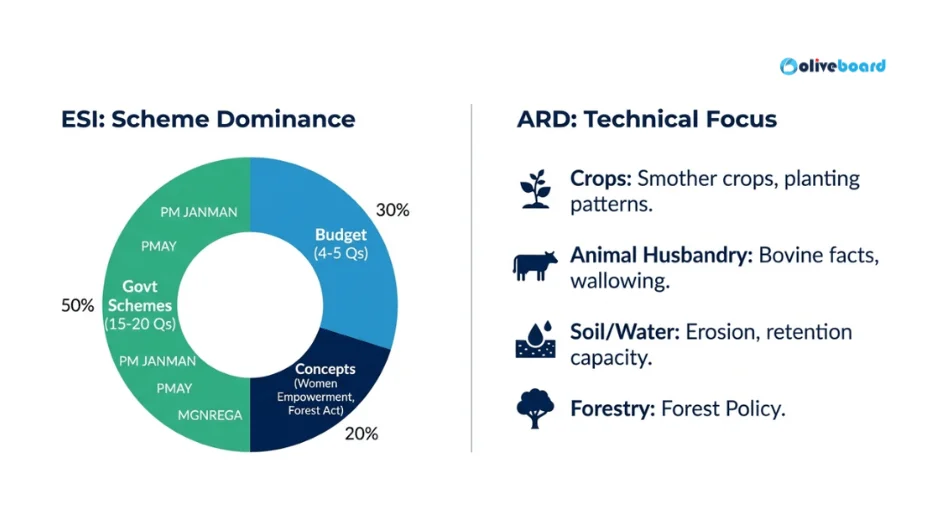
The Economic & Social Issues (ESI) section, with a focus on Rural India, is one of the most critical sections, accounting for 40 marks out of 200. This section includes questions related to the Indian economy, social issues, and rural development policies. Some of the topics from which most questions were asked are listed below. Once we receive the complete analysis, we will update the details as per this year’s exam.
- 4-5 Questions from Budget
- Women Empowerment
- 15-20 Questions from Schemes such as PM Janman, PMAY, PMGSY, MGNREGA, MIDH, PMFBY, e-NAM, PMMSY
- Forest Conservation Act
- NABARD-UNFCCC
NABARD Grade A Exam Analysis – ARD
The Agriculture & Rural Development (ARD) section, also worth 40 marks out of 200, focuses on topics related to agriculture and rural development. It is a key section for candidates aspiring to work in NABARD. Questions asked in the NABARD Grade A exam are as follows:
- Bovine
- NHB Head Quarter
- Smother Crop
- Forest Policy
- Wood
- MGNREGA Card Validity
- Wallowing
- SRR
- Egg laying peak period
- Macronutrient
- Water retention capacity
- Erosion
- Planting pattern
- Govardhan – R stands for
- IPCC formation
- IUCN
| Shifts | Detailed Exam Analysis |
| Shift 1 | NABARD Grade A Exam Analysis 20th December Shift 1 |
| Shift 2 | NABARD Grade A Exam Analysis 20th December Shift 2 |
NABARD Grade A Previous Year Exam Analysis
Understanding the previous year exam trends is crucial for cracking NABARD Grade A. It helps aspirants decode the difficulty level, section-wise weightage, and evolving focus areas of the exam.
In this section, we have provided a detailed Phase 1 and phase 2 exam analysis of NABARD Grade A 2024, 2023 covering overall difficulty, section-wise performance, and key takeaways based on candidate feedback and paper review.
NABARD Grade A phase 1 exam analysis 2024
The NABARD Grade A Phase 1 Exam 2024 was conducted on 1st September 2024 in two shifts and the paper was easy to moderate in difficulty. Compared to the last two years, the paper was more predictable, concept-driven, and favourable for candidates who focused on repeated topics, government schemes, and current affairs.
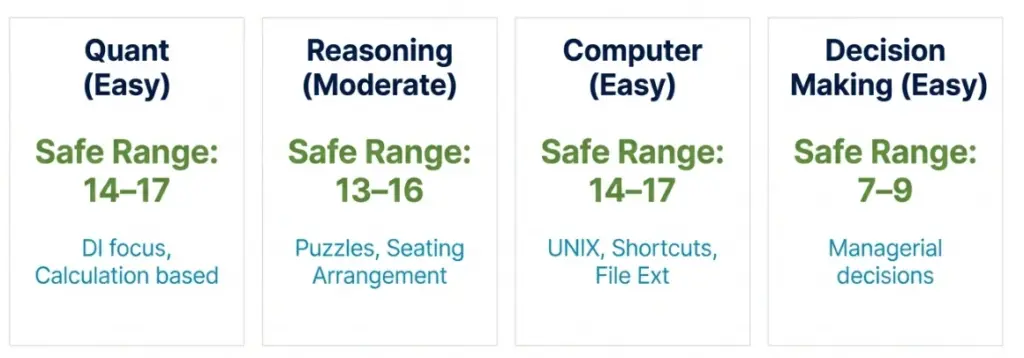
This detailed analysis covers section-wise difficulty level, key topics asked, and good attempts, helping aspirants assess their performance realistically.
| Section | Total Questions | Good Attempts (Safe Range) | Difficulty Level |
| ARD (Agriculture & Rural Development) | 40 | 30–35 | Very Easy |
| ESI (Economic & Social Issues) | 40 | 30–40 | Easy to Moderate |
| GA (General Awareness) | 40 | 22–28 | Moderate to Tough |
| Quantitative Aptitude | 20 | 14–17 | Easy |
| Reasoning Ability | 20 | 13–16 | Moderate |
| Decision Making | 10 | 7–9 | Easy |
| English Language | 40 | 26–32 | Moderate |
| Computer Awareness | 20 | 14–17 | Easy |
| Overall | 230 | 156–181 | Moderate |
How was the ESI (Economic & Social issues) section?
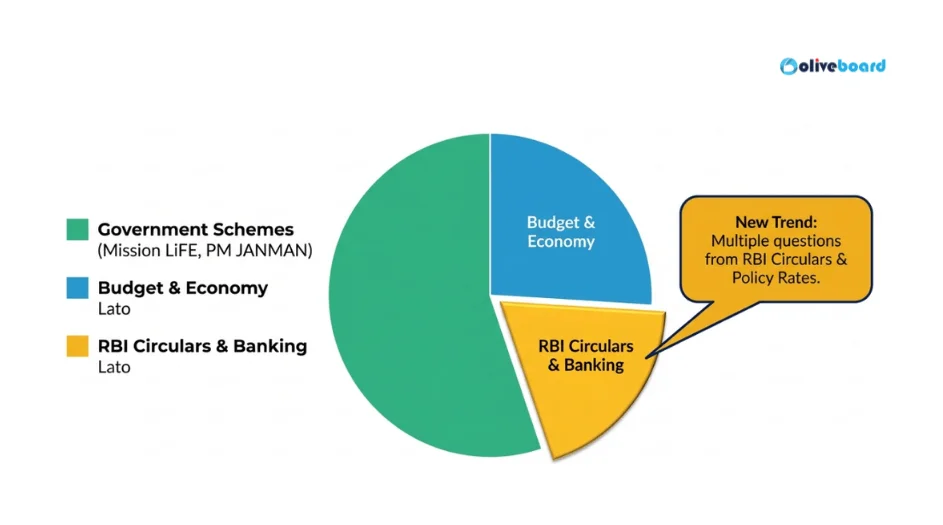
The ESI section was easy to moderate and largely current-affairs oriented. Most questions were directly linked to government schemes, PIB updates, and budget-related announcements. Candidates with regular current affairs preparation found this section comfortable.
- Strong focus on schemes and policy updates
- Factual questions with limited analytical demand
- Static concepts linked with current relevance
New trend noticed – For the first time, multiple questions were asked from RBI circulars and banking-related current affairs. While this surprised some candidates, it was still within the syllabus scope, especially in areas related to rural and agricultural finance.
| Area | Details covered |
| Government schemes & initiatives | Mission LiFE, PM Janman Yojana, PM Matsya Sampada Yojana, Eat Right India, National Action Plan on Climate Change (NAPCC), PURA Scheme (latest state: Odisha) |
| Budget & economic updates | Ethanol blending target (20% by 2025–26), E-voucher scheme for student loans (up to ₹10 lakh), Venture Capital Fund for space economy, Credit Risk Guarantee for affordable housing |
| Banking & finance | MPC policy rates (6.75%), Bulk deposit threshold increase, RIDF fund, PSL shortfall deposits, Single-branch FFMC net-owned fund requirement |
| Labour & social sector | MGNREGA (100 days), Chronology of labour laws, Child Labour Act enforcement portal (PENCIL) |
How was the ARD (Agriculture & Rural development) section?
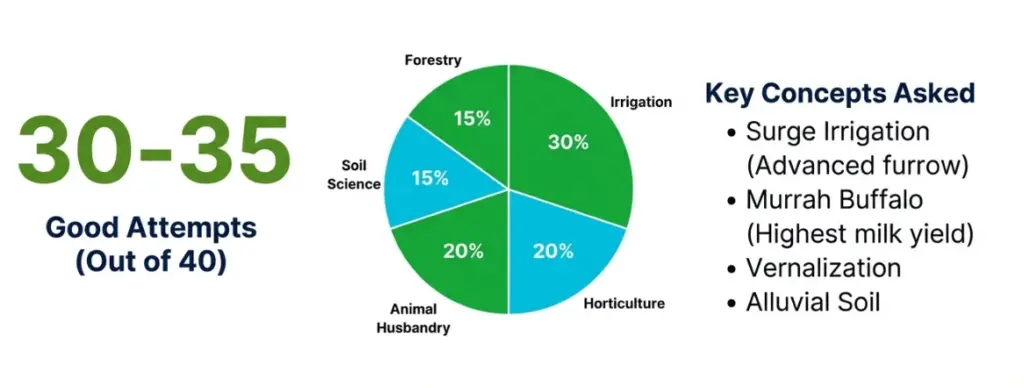
The ARD section was one of the easiest and most scoring sections in the last five years. Questions were mostly direct, factual, and already covered in marathon sessions and MCQ batches. There were no confusing or unexpected questions, and the paper clearly focused on core concepts rather than deep theoretical understanding. Options were framed in a way that allowed educated guessing.
- No confusing or out-of-the-box questions
- Heavy repetition from previous-year questions
- Concept-based questions over theoretical depth
- Options supported logical elimination
| Area | Topics asked |
| Irrigation techniques | Surge irrigation (advanced form of furrow irrigation), Subsurface drip irrigation (low pressure, high efficiency) |
| Extension education | Method demonstration vs Result demonstration, very limited scope with only core concepts |
| Horticulture & floriculture | Vernalization, Pre-cooling in cut flowers, Seedlessness in grapes (dominant gene) |
| Animal husbandry | Highest milk-yielding buffalo – Murrah, Weaning, Galactopoiesis, Let-down of milk |
| Agricultural engineering | PTO (Power Take-Off), Tractor attachments, Egg inversion during hatching |
| Soil science | Alluvial soil (largest area in India), Vertisols (low percentage but conceptually important) |
| Seeds & breeding | Seed chain (Nucleus → Breeder → Foundation → Certified), Cryopreservation using liquid nitrogen |
| Forestry & environment | Forest Conservation Act, 1980, Artificial ecosystems (crop fields) |
Which topics were covered in the GA (General Awareness) section?
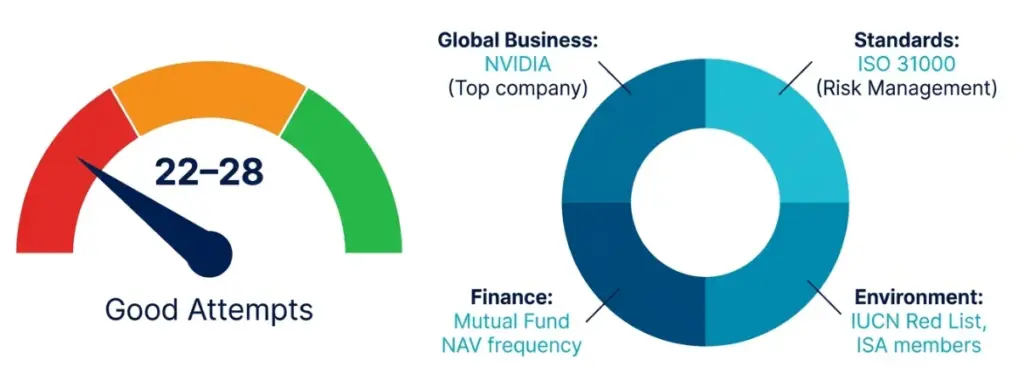
The GA section was the toughest among all sections, not because of difficulty, but due to its unorthodox structure. Many questions that candidates expected in ESI appeared in GA instead. Banking and finance questions dominated, while traditional static one-liners were fewer.
- Government schemes shifted from ESI to GA
- Heavy focus on banking and finance
- Fewer traditional static GK questions
| Areas | Topics asked |
| Standards | ISO 31000 (risk management) |
| Global business | Top global companies like NVIDIA |
| Finance basics | Mutual fund NAV frequency |
| Environment | IUCN Red List categories |
| International bodies | International Solar Alliance members |
| Infrastructure | Major ports under Green Tech transition |
| Culture & awards | Film awards and cultural current affairs |
Which topics were covered in the Quantitative Aptitude section?
The Quantitative Aptitude section was straightforward and scoring. Questions were familiar, calculation-based, and well within the expected difficulty level. No major complaints were reported by candidates.
- Data Interpretation – 2 sets
- Simplification
- Missing number series
- Ratio, mixture & allegation
- Profit & loss
- Time & work
- Income-expenditure
Which topics were covered in the Reasoning Ability section?
The Reasoning Ability section followed the standard NABARD exam pattern. The difficulty level remained similar to previous years, making it manageable for candidates with regular practice.
- Puzzles (multiple variables)
- Seating arrangement
- Blood relations
- Alpha-numeric series
- Logical reasoning
Which topics were covered in the Decision Making section?
The Decision Making section was easy and predictable. Questions were direct, concept-based, and involved minimal ambiguity. Candidates with clarity in basic management and ethics concepts found this section scoring.
- Organizational decisions
- Managerial decision-making
- Sunk cost bias
- Rule of thumb
- Policy and ethics-based scenarios
Which topics were covered in the English Language section?
The English Language section was moderate and scoring. The paper focused on standard comprehension and grammar-based questions without tricky vocabulary.
- Reading comprehension: 9 questions
- Sentence rearrangement
- Phrase replacement
- Error detection
- Fill in the blanks
Which topics were covered in the Computer Awareness section?
The Computer Awareness section focused on basic concepts. Questions were simple and direct, making it an easy scoring area for candidates with fundamental knowledge.
- Operating systems (UNIX)
- Software & hardware full forms
- MS Word shortcuts
- File extensions (PNG)
- Password security
- Networking basics
What was the overall level of the NABARD Grade A Phase 2 exam 2024?
The NABARD Grade A Phase 2 Exam 2024 was moderate to slightly above moderate in nature. The paper tested not only static knowledge but also conceptual clarity, recent data awareness, and application-based understanding. Candidates who prepared from previous year questions, government schemes, and core ARD–ESI topics found the paper manageable. Question selection played a crucial role, especially in the descriptive papers.
| Section | Difficulty Level | Nature of Questions |
| English Descriptive | Moderate | Topic-based, ARD–ESI linked |
| ESI & ARD Descriptive | Moderate | Direct, syllabus-oriented |
| ESI & ARD MCQs | Moderate to Above Moderate | Data + scheme based |
| Overall Paper | Moderate | Smart attempt mattered |
What were the questions asked in the English descriptive paper?
The English Descriptive paper was scoring for candidates who could link social, economic, agriculture, and development themes. There was no abstract creativity asked. Most topics had a clear ARD and ESI connection, and essays required structured, example-based answers.
| Component | Marks | Key Change |
| Essay (1 out of 4) | 40 | Word limit increased to 500–520 |
| Precis | 30 | Social media & development theme |
| Letter Writing | 30 | Practical & official topics |
| Total | 100 | Same structure as previous years |
Essay topics asked
- How can youth contribute to India’s progress in education, entrepreneurship, and social initiatives?
- How access to credit can increase sustainable farming practices in India?
- How integrating fish farming with agricultural crops enhances productivity and income?
- Looking deep into nature, everything happens for the better (philosophical)?
Key observation:
- Essay 1 was open-ended and safe
- Essay 2 & 3 were technical and ARD-heavy
- Essay 4 was risky but high scoring if written well
Precis topic
- Role of short video content in social media marketing
- Focus on Gen Z, digital platforms, and communication trends
Letter writing topics
| Letter Type | Topic |
| Official Complaint | Poor condition of roads to Municipal Corporation |
| Grievance Letter | Faulty electronic item delivered |
| Official Request | Extension of time to submit article |
How was the ESI and ARD descriptive paper structured?
The ESI & ARD Descriptive paper was very syllabus-aligned and predictable. Most questions were directly linked to previous year trends, answer writing practice, and government initiatives. Candidates who practiced structured answers with headings and examples had a clear advantage.
Compulsory 15-mark questions
| Question | Core Area |
| Post-harvest management, value addition & supply chain in horticulture | ARD |
| Financial inclusion transformation (2014–2024) | ESI |
| Institutional credit framework & rural credit measures | ARD |
10-mark questions asked
- Objectives and aims of PM Vishwakarma Scheme and SVAMITVA Scheme
- Short note on Dryland Farming
- Role of India’s storage system in agriculture and food security
What was the nature of ESI and ARD MCQs in phase 2?
The MCQs section was data-oriented, scheme-focused, and application-based. Many questions were inspired from previous years, but answers required latest figures and updated facts. Candidates who relied only on old data faced difficulty.
ARD MCQs focus areas
| Topic | Examples Asked |
| Livestock & Fisheries | Poultry meat contribution (51.4%) |
| Agriculture Census | Small farmer landholding |
| Cropping Seasons | Rabi–Kharif crops |
| Agroforestry | Types and systems |
| Storage Systems | Traditional & modern storage |
| Institutions | PACS, DCCBs, NABARD funds |
ESI MCQs focus areas
| Topic | Nature |
| Government Schemes | PM JANMAN, PM Vishwakarma |
| Labour Data | PLFS concepts |
| Agriculture & Economy | Workforce contribution |
| Environment & Sustainability | Natural farming |
| Reports & Indexes | IMF, debt index |
What was the overall difficulty level of the NABARD Grade A phase 1 2023 exam?
The NABARD Grade A Phase 1 exam was of moderate to tough level, with General Awareness and ARD/ESI playing a decisive role in the final score. In 2023 exam the paper tested not just speed but conceptual clarity, current affairs awareness, and section-wise balance. Candidates who were strong in static basics but weak in current affairs found it difficult to clear the cut-off.
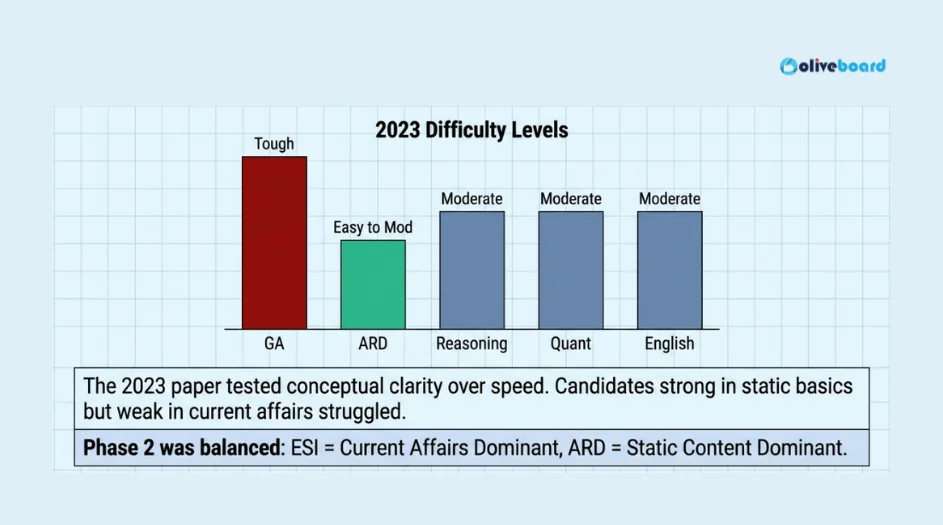
| Section | Difficulty Level |
| Reasoning Ability | Moderate |
| Quantitative Aptitude | Moderate |
| English Language | Moderate |
| General Awareness | Tough |
| Computer Knowledge | Moderate |
| Decision Making | Moderate |
| Economic & Social Issues (ESI) | Moderate |
| Agriculture & Rural Development (ARD) | Easy to Moderate |
| Overall | Moderate to Tough |
What was the section-wise exam analysis of NABARD Grade A phase 1 2023?
The 2023 Phase 1 paper leaned heavily on current affairs in GA and ARD, which influenced overall attempts and accuracy. While core aptitude sections were manageable, scoring high required strong preparation in banking, agriculture, and rural development-related updates. Static concepts helped, but only when backed by current relevance.
| Section | Difficulty | Key Focus |
| Reasoning Ability | Moderate | Puzzles & Seating |
| Quantitative Aptitude | Moderate | Arithmetic & DI |
| English Language | Moderate | RC & Grammar |
| General Awareness | Tough | Banking & Current Affairs |
| Computer Knowledge | Moderate | Basics |
| Decision Making | Moderate | Situational Questions |
| ESI | Moderate | Govt Schemes & Economy |
| ARD | Easy to Moderate | Static + Current |
What was the overall NABARD Grade A 2023 phase 2 exam analysis?
The NABARD Grade A 2023 Phase 2 exam was conducted on 19 November 2023. The exam included ESI & ARD (Objective and Descriptive) and Descriptive English. Based on candidate feedback and expert review, the paper was balanced and tested both static knowledge and current affairs. The overall difficulty level of the exam was moderate, making it achievable for well-prepared aspirants.
| Subject | Difficulty Level |
| Economic and Social Issues & Agriculture and Rural Development (Objective) | Easy to Moderate |
| Economic and Social Issues & Agriculture and Rural Development (Descriptive) | Moderate |
| Descriptive English | Moderate |
| Overall Exam Level | Moderate |
How was the ESI and ARD objective paper in NABARD Grade A phase 2 exam 2023?
The ESI & ARD Objective section focused mainly on ARD static topics and ESI current affairs. Government schemes played an important role, while reports and indices were not asked. The section tested both factual knowledge and conceptual understanding, especially in the 2-marker questions.
| Topic (ESI + ARD) | Number of Questions |
| Government Schemes | 9 |
| Reports / Indices | 0 |
| Union Budget / Economic Survey | 2 |
| ESI Current Affairs | 4 |
| ARD Static | 11 |
| ARD Current Affairs | 4 |
| ARD Reports | 0 |
| ESI Static | 0 |
ESI and ARD objective paper difficulty level
The details of the difficulty level of the ESI and ARD objective paper are as follows:
| Difficulty Level | Number of Questions |
| Easy | 12 – 13 |
| Moderate | 14 – 15 |
| Difficult | 2 – 3 |
Overview of the ESI and ARD objective paper
The overview of the difficulty level of the ESI and ARD objective paper is as follows:
- Majority of 1-marker questions came from ARD
- 2-marker questions needed deep understanding of concepts
- ESI and ARD had balanced importance
- Some schemes overlapped between ESI and ARD
- Current affairs were more important than static topics
- ARD was dominated by static content
- ESI was dominated by current affairs
- Paragraph-based questions were asked from:
- ARD Current Affairs
- ESI Current Affairs
- This trend is likely to continue
- Regular practice of quizzes and mock tests is very important
How was the ESI and ARD descriptive paper in NABARD Grade A 2023?
The ESI & ARD Descriptive paper tested candidates on their ability to explain concepts clearly and link them with real-world applications. Questions were equally divided between ESI and ARD, and several topics were repeated from previous years.
| Topic | Number of Questions |
| Rural Marketing | 1 |
| Agricultural Extension | 1 |
| Economics | 1 |
| Rural Development | 1 |
| Forestry | 1 |
| Demographic Trends | 1 |
ESI and ARD descriptive paper difficulty level
The details of the difficulty level of the ESI and ARD descriptive paper are as follows:
| Difficulty Level | Number of Questions |
| Easy | 1 |
| Moderate | 4 |
| Difficult | 1 |
| Total | 6 |
How was the NABARD Grade A 2023 English descriptive paper?
The Descriptive English paper tested essay writing, precis writing, and reading comprehension skills. The section was scoring for candidates who had practiced writing answers in exam-like conditions.
| Topic | Questions | Marks |
| Essay | 1 out of 4 topics | 30 |
| Precis | 1 | 30 |
| Reading Comprehension | 5 | 40 |
| Total | 7 | 100 |
English descriptive paper difficulty level
The details of the difficulty level of the English descriptive paper are as follows:
| Topic | Difficulty Level |
| Essay | Moderate |
| Precis | Moderate |
| Reading Comprehension | Moderate |
English descriptive paper key takeaways
The overview of the types of questions asked in the English descriptive paper is as follows:
- 4 essay topics were asked, similar to previous year
- Essay word limit was 500–550 words
- Precis and comprehension were moderately easy
- Essay topics were:
- Environment, Social and Governance (ESG) norms
- Organizational culture
- Social healthcare expenditure
- Automation and artificial intelligence
- Precis passage topic:
- The Evolution of Gaming
- Reading comprehension passage topic:
- Emergence of social media influencers
- Regular answer writing improves scores
- Strong content knowledge gives an edge in final merit
FAQs
The overall difficulty of NABARD Grade A Exam was Moderate.
- SEBI IT Officer Syllabus 2026, Exam Pattern, Download PDF
- SEBI Law Officer Recruitment 2026, Download Notification PDF
- SEBI IT Officer Recruitment 2026 Notification, Download PDF
- SEBI Legal Officer Syllabus 2026 & Exam Pattern, Download PDF
- ESI & ARD Practice Questions for NABARD Grade A 2026
- RBI Grade B 2026 Practice Quiz, Download Free PDF

Hi, I’m Aditi. I work as a Content Writer at Oliveboard, where I have been simplifying exam-related content for the past 4 years. I create clear and easy-to-understand guides for JAIIB, CAIIB, and UGC exams. My work includes breaking down notifications, admit cards, and exam updates, as well as preparing study plans and subject-wise strategies.
My goal is to support working professionals in managing their exam preparation alongside a full-time job and to help them achieve career growth.