

Interest problems are a highly scoring topic in SBI PO exams. Simple and Compound Interest questions often appear in both Prelims and Mains. While they may look intimidating, most of these problems can be solved quickly if you know the formulas, shortcuts, and a systematic approach. This article explains what SI and CI are, the formulas, step-by-step solving methods, and sample questions with solutions.
Understanding Simple and Compound Interest
Interest is the cost of borrowing or the gain from investing money. There are two types:
- Simple Interest (SI): Calculated only on the original principal amount throughout the investment or loan period. It remains constant every year.
- Compound Interest (CI): Calculated on the principal and accumulated interest. Each year, the interest is added to the principal, so the total grows faster.
Understanding the difference between SI and CI is crucial, as exam questions often test this concept.
Simple and Compound Interest Formulas
Knowing the correct formulas is essential to solve any question accurately:
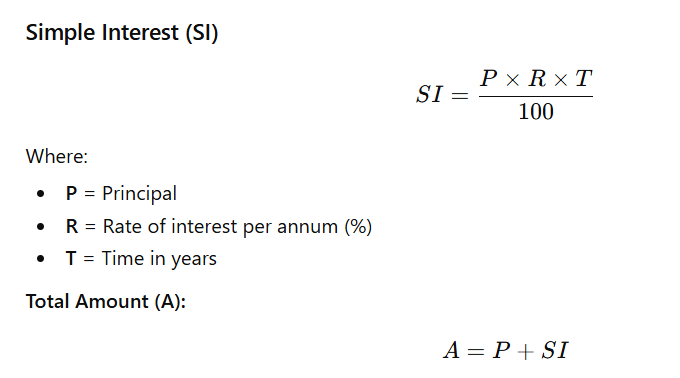
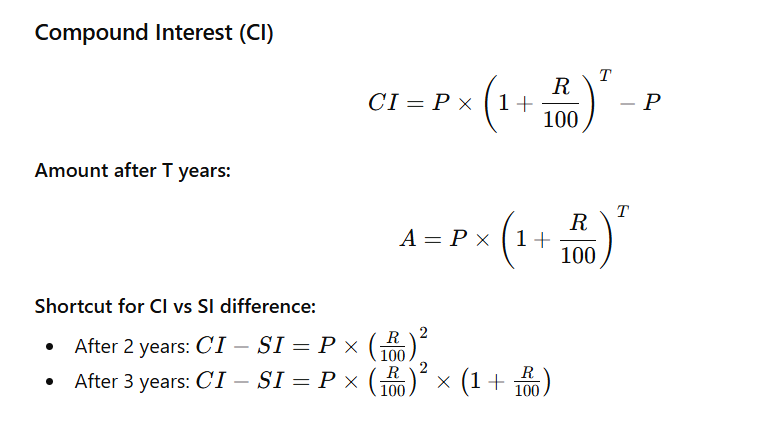
How to Solve SI & CI Problems in SBI PO?
To solve interest problems efficiently in exams, follow these steps:
- Identify the type of interest: Determine whether the problem involves SI, CI, or the difference between them.
- Extract the given values: Write down principal (P), rate (R), and time (T) clearly.
- Choose the correct formula: Use SI formula for SI questions, CI formula for CI questions, and shortcuts for CI-SI differences.
- Step-by-step calculation:
- For SI: Multiply P × R × T ÷ 100
- For CI: Either use the formula or calculate year by year if it’s mentally easier
- Use shortcuts whenever possible: Especially for 2–3 year CI vs SI differences.
- Check the answer: CI must always be greater than SI; verify if the solution is reasonable.
- Apply elimination: If options are widely apart, rough calculation may suffice.
Sample Questions with Detailed Solutions
Solve some practice questions for the SBI PO Quant.
Question 1: Find the difference between the compound interest and simple interest if Rs. 64,000 is lent at 10% per annum for 3 years.
Solution: Use the shortcut formula for CI-SI difference for 3 years: CI−SI=P×(R100)2×(1+R100)=64000×(0.1)2×1.1=1984CI – SI = P \times \left(\frac{R}{100}\right)^2 \times \left(1 + \frac{R}{100}\right) = 64000 \times (0.1)^2 \times 1.1 = 1984CI−SI=P×(100R)2×(1+100R)=64000×(0.1)2×1.1=1984
Answer: Rs. 1984
Question 2: A man invests in a scheme offering simple interest. The total amount received at the end of 4th year is Rs. 7984 and at the end of 5th year is Rs. 8108. Find the principal.
Solution:
- Interest for 5th year = 8108 – 7984 = 124
- Principal = Amount at 4th year – (SI for 4 years) = 7984 – (124 × 4) = 7488
Answer: Rs. 7488
Question 3: Amir invested Rs. 18,000 in a scheme offering 20% compound interest per annum for 2 years. Find the interest earned.
Solution:
- Amount after 2 years: A=18000×(1+0.2)2=18000×1.44=25920A = 18000 \times (1 + 0.2)^2 = 18000 \times 1.44 = 25920A=18000×(1+0.2)2=18000×1.44=25920
- Compound Interest = 25920 – 18000 = 7920
Answer: Rs. 7920
Question 4: Raman deposited Rs. 16,000 at 20% compound interest and Rs. 12,000 at 30% simple interest per annum. What will be the difference in the interest after 2 years?
Solution:
- CI on Rs. 16,000 for 2 years: 16000 × (1.2)^2 – 16000 = 7040
- SI on Rs. 12,000 for 2 years: 12000 × 30 × 2 / 100 = 7200
- Difference = 7200 – 7040 = 160
Answer: Rs. 160
Quick Tips and Tricks for SBI PO SI/CI
Mastering Simple and Compound Interest is not just about knowing formulas—it’s also about using shortcuts, avoiding calculation mistakes, and solving questions quickly under exam conditions. The following tips will help you maximize accuracy while saving time in both Prelims and Mains exams.
- Use CI-SI shortcuts: For 2–3 year differences between compound and simple interest, apply the shortcut formulas to save time instead of calculating year by year.
- Approximate large numbers mentally: Quickly estimate results to eliminate unlikely options, then refine your calculation for accuracy.
- Year-by-year CI calculations for small T: When the period is 2–3 years, breaking the calculation into yearly interest prevents mistakes.
- Eliminate impossible options first: If multiple-choice options are widely different, ruling out unlikely answers can reduce calculation time.
- Combine SI and CI carefully in mixed problems: When a question involves both simple and compound interest, calculate each separately, then combine carefully to avoid errors.
- Practice regularly: Solve 15–20 questions daily from past SBI PO papers or mock tests to internalize patterns and improve speed.
- Time & Work Questions for SBI PO Mains, FREE PDF & Quiz
- Compound Interest Questions for SBI PO Mains, FREE PDF & Quiz
- Simple Interest Questions for SBI PO Mains, FREE PDF & Quiz
- Percentage Questions for SBI PO Mains, FREE PDF & Quiz
- Ratio and Proportion for SBI PO Mains, FREE PDF & Live Quiz
- Syllogism Questions for SBI PO Mains, FREE Practice PDF & Quiz

Hi, I’m Tripti, a senior content writer at Oliveboard, where I manage blog content along with community engagement across platforms like Telegram and WhatsApp. With 3+ years of experience in content and SEO optimization related to banking exams, I have led content for popular exams like SSC, banking, railway, and state exams.