
The General Awareness section in SSC CGL Tier 2 is important for scoring high marks. It tests your knowledge of current events, history, geography, economy, polity, culture, and science. Practicing most repeated and high-difficulty questions can help identify patterns, save time in the exam, and improve accuracy. In this blog, 100 most repeated General Awareness questions for SSC CGL Tier 2 are provided along with some sample questions below.
Download 100 Most Repeated General Awareness Questions PDF
To access all 100 most repeated General Awareness questions for SSC CGL Tier 2, download the PDF below. These questions are based on the SSC CGL GA Syllabus and include high-difficulty level questions with detailed solutions for complete preparation.
Most Repeated General Awareness Questions for SSC CGL Tier 2
Here are some most repeated and SSC CGL GA questions for SSC CGL Exam, Tier 2:
Q1. Which treaty led to the establishment of the League of Nations after World War I?
a) Treaty of Versailles
b) Treaty of Tordesillas
c) Treaty of Paris
d) Treaty of Ghent
Answer: a) Treaty of Versailles
Q2. The nitrogen cycle in nature primarily involves which of the following bacteria?
a) Azotobacter and Rhizobium
b) Lactobacillus and Streptococcus
c) Bacillus and Clostridium
d) E. coli and Salmonella
Answer: a) Azotobacter and Rhizobium
If such questions feel confusing, it usually means the basics aren’t fully clear. Enroll in our Foundation Courses to clear concepts along with systematic GK coverage.
Q3. Which organisation releases the Global Innovation Index, in which India improved its rank in 2025?
A) World Bank
B) WIPO
C) OECD
D) IMF
Answer: B) WIPO
Explanation: The Global Innovation Index is published annually by the World Intellectual Property Organization.
Q4. Who was the founder of the Gupta Dynasty?
a) Chandragupta I
b) Samudragupta
c) Chandragupta Maurya
d) Skandagupta
Answer: a) Chandragupta I
Q5. Which Indian constitutional amendment introduced the Goods and Services Tax (GST)?
a) 101st
b) 95th
c) 73rd
d) 84th
Answer: a) 101st
Q6. Which of the following is NOT a noble gas?
A) Helium
B) Neon
C) Argon
D) Nitrogen
Answer: D) Nitrogen
Explanation: Nitrogen is a reactive gas and does not belong to the noble gas group.
Q7. Who was the first Indian to win a Nobel Prize?
A) Rabindranath Tagore
B) C.V. Raman
C) Hargobind Khorana
D) Amartya Sen
Answer: A) Rabindranath Tagore
Explanation: He won the Nobel Prize in Literature in 1913.
Q8. The Indian Space Research Organisation (ISRO) was established in:
A) 1962
B) 1969
C) 1975
D) 1980
Answer: B) 1969
Explanation: ISRO was founded in 1969 under the leadership of Vikram Sarabhai.
Q9. The term “Green GDP” primarily aims to include:
A) Informal sector output
B) Digital economy value
C) Environmental degradation costs
D) Agricultural subsidies
Answer: C) Environmental degradation costs
Explanation: Green GDP adjusts economic growth by accounting for environmental damage.
Q10. The Standard Model in Physics explains which of the following?
a) Fundamental particles and forces
b) Thermodynamics of gases
c) Motion of planets
d) Properties of light only
Answer: a) Fundamental particles and forces
Start using the 360° Study Kit after every class for retention (notes, practice, revision, tests). and finish your revision in just 10 minutes.
Q11. Which of the following is considered a man-made forest?
a) Gir Forest
b) Sal Forest
c) Van Vigyan Kendra
d) Mangrove plantations
Answer: d) Mangrove plantations
Q12. The principle of ‘One Vote, One Value’ is associated with which constitutional article?
a) Article 326
b) Article 356
c) Article 370
d) Article 14
Answer: a) Article 326
Q13. The most abundant element in Earth’s crust is:
a) Oxygen
b) Silicon
c) Aluminum
d) Iron
Answer: a) Oxygen
Q14. Which acid is present in vinegar?
a) Acetic Acid
b) Citric Acid
c) Lactic Acid
d) Sulfuric Acid
Answer: a) Acetic Acid
Q15. Which Mughal emperor built the Shalimar Gardens in Kashmir?
a) Jahangir
b) Shah Jahan
c) Akbar
d) Aurangzeb
Answer: a) Jahangir
Q16. Which of the following diseases is caused by protozoa?
a) Malaria
b) Tuberculosis
c) Influenza
d) Cholera
Answer: a) Malaria
Q17. The concept of ‘Directive Principles of State Policy’ is borrowed from which country?
a) Ireland
b) USA
c) UK
d) Australia
Answer: a) Ireland
Q18. Which Indian mountain range is geologically the youngest?
a) Himalayas
b) Aravalli
c) Vindhya
d) Satpura
Answer: a) Himalayas
Q19. Who invented the process of vaccination?
a) Edward Jenner
b) Louis Pasteur
c) Robert Koch
d) Alexander Fleming
Answer: a) Edward Jenner
Q20. The classical dance form Sattriya originated in:
A) Manipur
B) Assam
C) Odisha
D) Tripura
Answer: B) Assam
Explanation: Sattriya developed in Assam’s Vaishnav monasteries known as Satras.
Q21. The Finance Commission that recommended grants for disaster management for 2026 onwards is the:
A) 14th
B) 15th
C) 16th
D) 17th
Answer: C) 16th
Explanation: The 16th Finance Commission covers the period starting from 2026–27.
Q22. The concept of “Demographic Dividend” is directly linked to:
A) Life expectancy
B) Dependency ratio
C) Infant mortality rate
D) Sex ratio
Answer: B) Dependency ratio
Explanation: A lower dependency ratio increases economic productivity.
Q23. Which river system does the Hirakud Dam belong to?
A) Godavari
B) Mahanadi
C) Krishna
D) Cauvery
Answer: B) Mahanadi
Explanation: Hirakud Dam is built across the Mahanadi River in Odisha.
Q24. India’s Digital Public Infrastructure (DPI) model was showcased globally in 2025 at forums led by:
A) IMF & World Bank
B) WHO
C) UNDP
D) WTO
Answer: A) IMF & World Bank
Explanation: These institutions highlighted India’s DPI model for financial inclusion.
Q24. The National Quantum Mission approved by India aims to be implemented till:
A) 2028-29
B) 2030-31
C) 2031-32
D) 2035-36
Answer: B) 2030-31
Explanation: The mission spans from 2023-24 to 2030-31.
Q25. The term “Stagflation” refers to:
A) High growth with inflation
B) Low growth with deflation
C) High inflation with unemployment
D) Economic recovery phase
Answer: C) High inflation with unemployment
Explanation: Stagflation combines economic stagnation and rising prices.
Q26. Which fundamental right is available ONLY to citizens and not foreigners?
A) Right to Equality
B) Right to Religion
C) Right to Freedom of Speech
D) Right to Life
Answer: C) Right to Freedom of Speech
Explanation: Article 19 rights are exclusively available to citizens.
Q27. The Governor of a state holds office during the pleasure of:
A) Prime Minister
B) Parliament
C) President
D) Chief Minister
Answer: C) President
Explanation: Governors are appointed by and serve at the pleasure of the President.
Q28. Which body conducts the Periodic Labour Force Survey (PLFS)?
A) RBI
B) NITI Aayog
C) NSO
D) Labour Bureau
Answer: C) NSO
Explanation: PLFS is conducted by the National Statistical Office.
Q29. In 2025, India became the world’s largest producer of which agricultural commodity?
A) Rice
B) Wheat
C) Sugar
D) Pulses
Answer: A) Rice
Explanation: India surpassed China to become the largest rice producer.
Q30. India’s first AI-powered weather forecasting model, launched operationally in 2025, was developed by:
A) IIT Bombay
B) ISRO
C) IMD
D) IITM Pune
Answer: D) IITM Pune
Explanation: IITM Pune developed the AI-based weather model for IMD.
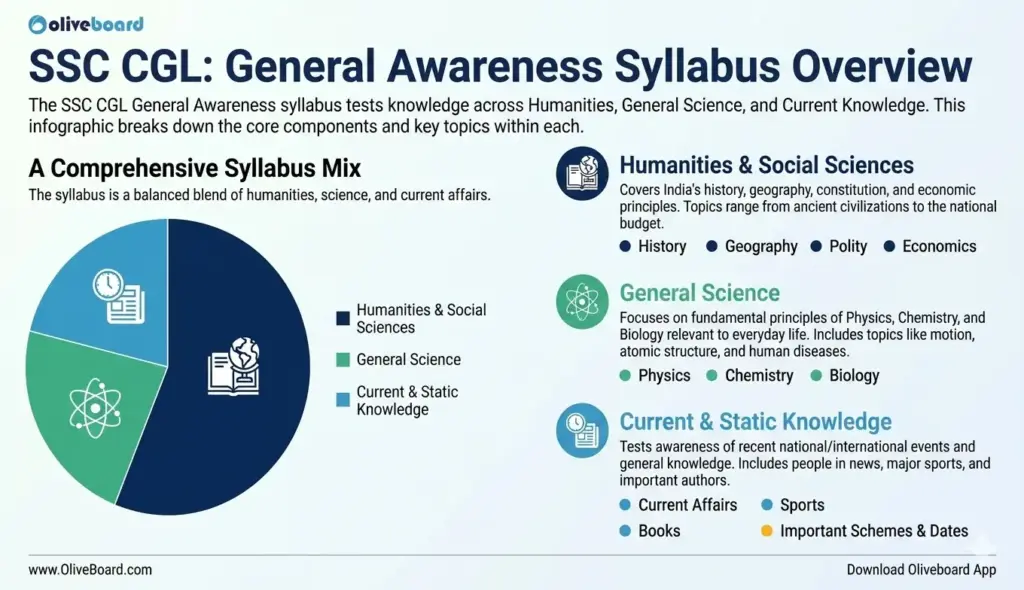
SSC CGL General Awareness Syllabus
The General Awareness questions in the SSC CGL General Awareness Syllabus assess a candidate’s knowledge of the world around them, including society, current events, and everyday scientific observations
| SSC CGL GA Syllabus |
| History: 1. Indus Valley and Civilization 2. Buddhism and Jainism In India 3. The Magadha Empire 4. Gupta Dynasty 5. Delhi Sultanate and Mughal Empire 6. India and its Independence. |
| Geography: 1. The Universe and the Solar System 2. Earth 3. Mountains and Rivers 4. Hydrosphere, Lithosphere, Atmosphere 5. Wind Cyclone 6. Climate 7. Geological Survey Of India 8. Indian Climate, Natural Vegetation And Soil |
| Economic: 1. General Economics 2. Economic Planning 3. National Income Of India 4. Budget 5. Market 6. Demand and Supply 7. Economic Concept 8. Population of India, Mortery Rate, Unemployment |
| Polity: 1. Constitutional Development of India 2. State, Union Territory 3. Fundamental Rights 4. Directive Principals of State Policy 5. Executive, Legislation, Judiciary 6. Constitution of India |
| Physics: 1. Unita and Measurement 2. Waves and Motion 3. Light 4. Work and Energy 5. Heat and Temperature |
| Chemistry: 1. Chemical Symbol and Formulae 2. Atomic Structure 3. Periodic Classification 4. Chemical Bonding 5. Oxidation and Reduction 6. Acid, Bases and Salts 7. Carbon and its Compounds 8. Fuels 9. Metals and Non Metal 10. Man Made Substances |
| Biology: 1. Living and Non-Living 2. Cell and Its Structure 3. Genetics 4. Organic Evaluation 5. Plant Morphology 6. Plant Diseases 7. Nitrogen Cycle 8. Animal Kingdom 9. Animal Tissue 10. Human Diseases |
| Current Affairs |
| Books and Authors |
| Sports |
| Important Schemes |
| Important Days & Dates |
| Portfolio |
| People in News |
How to Prepare for SSC CGL General Awareness Section?
Below are the points to remember while preparing for SSC CGL GA:
- Focus on high-weightage topics like Current Affairs, Polity, and History.
- Solve previous year papers and identify repeated patterns.
- Read daily current affairs from reliable sources.
- Maintain a notebook for formulas, important dates, and facts.
- Take timed mock tests to improve speed and accuracy.
Also check out: SSC CGL Typing Test Errors to minimize your errors in Data Entry Speed Test.
Key Takeaways:
Below are the key takeaways:
- Practicing most repeated GA questions helps understand SSC CGL General Awareness section.
- Focus on high-weightage topics like History, Geography, Economy, Society, Environment, Science, and Current Affairs.
- Attempting high-difficulty questions improves speed and accuracy.
- Reviewing detailed solutions enhances concept clarity and retention.
- Regular practice with timed sessions boosts confidence for Tier 2 exam.
Get ready for Tier 2 Exam, check out the below blogs:
FAQs
Ans. The General Awareness section tests your knowledge of current events, history, geography, economy, science, and society. It helps in scoring well and improving overall ranking.
Ans. The number of questions varies by year, but practicing 100 most repeated questions ensures coverage of important topics.
Ans. Focus on History, Geography, Economy, Society, Environment, Science, and Current Affairs.
Ans. Yes, these questions are compiled from previous years’ papers and repeated high-difficulty questions.
Ans. Practicing these questions improves accuracy, speed, concept clarity, and helps identify frequently asked topics.
- Average Problems for SSC Exams, Practice Questions with Solutions
- SSC CGL Previous Year General Awareness Questions in Quiz Format
- Top 100 SSC CGL General Awareness Questions, Download PDF
- 1000 SSC CGL General Knowledge Questions, Attempt Now
- IBPS PO vs SSC CGL vs RBI Assistant: Complete Comparison
- SSC CGL vs RBI Assistant: Salary Job Profile Comparison 2026 Guide

I’m Mahima Khurana, a writer with a strong passion for creating meaningful, learner-focused content especially in the field of competitive exam preparation. From authoring books and developing thousands of practice questions to crafting articles and study material, I specialize in transforming complex exam-related topics into clear, engaging, and accessible content. I have first hand experience of 5+ months in SSC Exams. Writing, for me, is not just a skill but a way to support and guide aspirants through their preparation journey one well-written explanation at a time.