
Key Takeaways
- Preparing for the SSC CGL Tier 2 GA section requires efficient revision due to a wide syllabus.
- One-liner facts help quickly recall important elements from History, Geography, Polity, Economy, Science, and Current Affairs.
- Revise static GK daily and focus on current events from the last 12 months for effective preparation.
- Using resources like mock tests and concise notes can enhance speed and accuracy in answering questions.
- Around 25 questions are asked in GA, so consistent daily study is essential.
Preparing for the General Awareness (GA) section of SSC CGL Tier 2 can be challenging because of the wide syllabus. The best way to revise quickly before the exam is through one-liner facts. These help you recall important points faster and improve your score in less time. This blog covers important SSC CGL Exam questions quick revision notes for History, Geography, Polity, Economy, Science, and Current Affairs, all in one-liner format.
1. Indian History, One Liner Facts
History is an important part for the Tier 2 stage. Revise key historical events and freedom movement highlights.
| Topic | One-Liner Fact |
| Battle of Plassey | Fought in 1757 between the British East India Company and Siraj-ud-Daulah. |
| First Governor-General of India | Lord William Bentinck (1828–1835). |
| Indian National Congress Founded | 1885 by A.O. Hume. |
| Civil Disobedience Movement | Started in 1930 by Mahatma Gandhi with the Salt March. |
| Quit India Movement | Launched in 1942 by Mahatma Gandhi demanding British withdrawal. |
| First Battle of Panipat | Fought in 1526 between Babur and Ibrahim Lodi. |
| Second Battle of Panipat | Fought in 1556 between Akbar and Hemu. |
| Third Battle of Panipat | Fought in 1761 between Marathas and Ahmad Shah Abdali. |
| First War of Indian Independence | 1857 revolt against British East India Company. |
| Bengal Renaissance | Cultural, social, and intellectual reform movement in 19th century Bengal. |
| Arya Samaj Founded | 1875 by Swami Dayananda Saraswati to promote Vedic values. |
| Aligarh Movement | Initiated by Sir Syed Ahmed Khan in the late 19th century for Muslim education. |
| Khilafat Movement | 1919–1924, aimed at protecting the Ottoman Caliphate. |
| Simon Commission Boycott | 1928, all Indian political parties boycotted due to no Indian members. |
| Formation of All India Muslim League | 1906 in Dhaka to protect Muslim political interests. |
| Rowlatt Act | 1919, allowed imprisonment without trial; led to widespread protests. |
| Jallianwala Bagh Massacre | 1919 in Amritsar; General Dyer ordered firing on unarmed civilians. |
| Champaran Satyagraha | 1917, Mahatma Gandhi led indigo farmers against British landlords. |
| Kheda Satyagraha | 1918, Gandhi helped peasants in Gujarat suffering from crop failure. |
| Home Rule Movement | 1916, launched by Annie Besant and Bal Gangadhar Tilak. |
| Partition of Bengal | 1905 by Lord Curzon; later annulled in 1911 due to protests. |
| Non-Cooperation Movement | 1920–22, led by Gandhi after the Jallianwala Bagh incident. |
| Simon Commission | 1927, all Indian political parties boycotted it. |
| Poona Pact | 1932 agreement between Gandhi and Ambedkar for Dalit representation. |
| Lahore Session of Congress | 1929, Purna Swaraj (complete independence) declared. |
| Dandi March | 1930, Gandhi’s Salt March against British salt tax. |
| Cripps Mission | 1942, failed attempt to secure Indian cooperation in WWII. |
| Mountbatten Plan | 1947, plan for partition and transfer of power to India and Pakistan. |
| Adoption of Indian Constitution | 26th January 1950, India became a republic. |
| First Prime Minister of India | Jawaharlal Nehru (1947–1964). |
| First Battle of Tarain | 1191, Prithviraj Chauhan defeated Muhammad Ghori. |
| Second Battle of Tarain | 1192, Muhammad Ghori defeated Prithviraj Chauhan. |
| Establishment of Delhi Sultanate | 1206 by Qutb-ud-din Aibak. |
| First Mughal Emperor | Babur (1526–1530). |
| Akbar’s Reign | 1556–1605; established Din-i-Ilahi and centralized administration. |
| Jahangir’s Reign | 1605–1627; known for administrative reforms and patronage of arts. |
| Shah Jahan | 1628–1658; built the Taj Mahal. |
| Aurangzeb | 1658–1707; known for expansion of Mughal Empire and orthodox policies. |
| Battle of Haldighati | 1576, Rana Pratap vs. Akbar. |
| Maratha Empire Founder | Chhatrapati Shivaji Maharaj, crowned in 1674. |
| Anglo-Mysore Wars | Four wars (1767–1799) between Mysore (Tipu Sultan) and British. |
| Anglo-Maratha Wars | Three wars (1775–1818) that led to British control over Marathas. |
| Anglo-Sikh Wars | Two wars (1845–1849) that annexed Punjab to British India. |
| Formation of Indian National Army | 1942, led by Subhas Chandra Bose to fight British. |
| Bengal Famine | 1943, caused millions of deaths under British rule. |
| Charter Act of 1813 | Allowed missionaries to propagate education and religion in India. |
| Vernacular Press Act | 1878, restricted freedom of Indian language press. |
| Indigo Revolt | 1859–60, farmers revolted against oppressive indigo planters in Bengal. |
| Battle of Plassey Outcome | British East India Company gained control over Bengal. |
| Revolt of 1857 Leaders | Mangal Pandey, Rani Laxmi Bai, Tatya Tope, Begum Hazrat Mahal. |
| Partition of India | 1947, led to creation of India and Pakistan. |
| Mountbatten Award | 1947, last Viceroy Lord Mountbatten awarded for peaceful transfer of power. |
| Gandhi-Irwin Pact | 1931, agreement to suspend civil disobedience movement. |
| Formation of Swaraj Party | 1923, Chittaranjan Das and Motilal Nehru formed it to enter councils. |
| Champaran Movement Success | Led to withdrawal of indigo planters and concessions to farmers. |
| Non-Brahmin Movement | 1916–20, social reform movements in South India led by Periyar and others. |
| Simon Commission Protest Leaders | Lala Lajpat Rai, Motilal Nehru, Annie Besant. |
Finding History difficult to retain? Enroll in our Foundation Courses to clear concepts along with systematic GK coverage.
2. Indian Geography One Liner Facts
Geography section covers facts cover physical, political, and economic geography topics.
| Topic | One-Liner Fact |
| Highest Peak in India | Kanchenjunga (8,586 m) in Sikkim. |
| Longest River in India | Ganga (2,525 km). |
| Tropic of Cancer Passes Through | 8 Indian states: Gujarat, Rajasthan, MP, Chhattisgarh, Jharkhand, West Bengal, Tripura, Mizoram. |
| Largest State by Area | Rajasthan (342,239 sq km). |
| Largest Producer of Rice | West Bengal. |
| Longest Coastline in India | Gujarat (~1,600 km). |
| Largest River Basin | Ganga Basin. |
| Smallest State by Area | Goa (3,702 sq km). |
| Largest Island | Andaman Island. |
| Longest Mountain Range in India | Himalayas (~2,400 km). |
| Highest Peak Outside Himalayas | Anamudi, Kerala (2,695 m). |
| Major Desert | Thar Desert, Rajasthan. |
| Longest Railway Bridge | Bogibeel Bridge, Assam. |
| Major National Parks | Jim Corbett, Kaziranga, Gir, Ranthambore. |
| Largest Lake in India | Vembanad Lake, Kerala. |
| Largest Saltwater Lake | Chilika Lake, Odisha. |
| Longest River in Peninsular India | Godavari (1,465 km). |
| Widest River in India | Brahmaputra. |
| Deepest River Gorge | Kali Gandaki Gorge. |
| Westernmost Point of India | Guhar Moti, Gujarat. |
| Easternmost Point of India | Kibithu, Arunachal Pradesh. |
| Northernmost Point of India | Siachen Glacier, Ladakh. |
| Southernmost Point of India | Indira Point, Andaman & Nicobar. |
| Major Coal Producing State | Jharkhand. |
| Major Iron Ore Producing State | Odisha. |
| Largest Producer of Tea | Assam. |
| Major Oil-Producing State | Assam, Gujarat. |
| Major Port on West Coast | Mumbai Port, Gujarat Ports. |
| Major Port on East Coast | Chennai Port, Visakhapatnam Port. |
| Largest State by Population | Uttar Pradesh. |
| Smallest Union Territory by Area | Lakshadweep. |
| Important Deserts | Thar, Rann of Kutch. |
| Major River Deltas | Ganga-Brahmaputra, Godavari-Krishna. |
| Important Wildlife Sanctuaries | Periyar, Sunderbans, Ranthambore. |
| Major Wetlands | Chilika Lake, Loktak Lake. |
| Important Mountain Passes | Rohtang, Zoji La, Nathu La. |
| Major Seas Surrounding India | Arabian Sea, Bay of Bengal, Laccadive Sea. |
| Important Islands | Andaman, Nicobar, Lakshadweep. |
| Rainfall Pattern | Western Ghats and North-East India receive highest rainfall. |
| Important Soil Types | Alluvial, Black, Red, Laterite, Desert, Mountain. |
| Largest River Island | Majuli, Assam. |
| Longest Highway | NH44 (Hyderabad to Srinagar, ~3,745 km). |
| Important Deserts | Thar Desert, cold deserts of Ladakh. |
| Major Waterfalls | Jog Falls (Karnataka), Dudhsagar Falls (Goa/Karnataka). |
| Longest Canal | Indira Gandhi Canal, Rajasthan. |
| Important Lakes | Dal Lake (J&K), Sambhar Lake (Rajasthan). |
| Important Peninsulas | Indian Peninsula – Deccan Plateau. |
| Major Mountain Ranges | Himalayas, Western Ghats, Eastern Ghats, Aravalli, Vindhya, Satpura. |
| Natural Resources | Coal, Iron, Bauxite, Mica, Petroleum. |
| Monsoon Arrival | Kerala Monsoon – 1st June, North-East Monsoon – October. |
| Major Deltas | Sundarbans (Ganga-Brahmaputra), Mahanadi, Godavari, Krishna, Kaveri. |
| Island Groups | Andaman & Nicobar, Lakshadweep. |
| Longest Tunnel | Atal Tunnel, Rohtang Pass (~9 km). |
| Highest Railway Station | Ghum, West Bengal (~2,258 m). |
| Major Desert Festivals | Desert Festival – Jaisalmer, Rajasthan. |
3. Indian Polity One Liner Facts
Polity is important for constitutional and governance-related questions.
| Topic | One-Liner Fact |
| Father of Indian Constitution | Dr. B.R. Ambedkar |
| Longest Written Constitution | Indian Constitution |
| Fundamental Rights | Part III of the Constitution |
| Directive Principles of State Policy | Part IV of the Constitution |
| Total Number of Amendments | More than 100 |
| President of India Elected By | Electoral College |
| Vice President of India Elected By | Members of Rajya Sabha & Lok Sabha |
| Prime Minister of India | Head of Government |
| Chief Justice of India Appointed By | President of India |
| Parliament of India | Bicameral (Lok Sabha & Rajya Sabha) |
| Total Number of States | 28 |
| Total Number of Union Territories | 8 |
| Speaker of Lok Sabha | Elected by Lok Sabha Members |
| Leader of Opposition | Recognized in Lok Sabha & Rajya Sabha |
| State Governor | Appointed by President of India |
| Constitutional Head of State | President of India |
| Council of Ministers | Headed by Prime Minister |
| Fundamental Duties | Part IV-A of the Constitution |
| Emergency Provisions | Part XVIII (Articles 352, 356, 360) |
| Election Commission of India | Constitutional body for elections |
| Attorney General of India | Legal advisor to the Government of India |
| Comptroller & Auditor General | Audits all government accounts |
| Finance Commission | Recommends distribution of revenues |
| Planning Commission | Replaced by NITI Aayog in 2015 |
| Rajya Sabha Members | 245 (Maximum) |
| Lok Sabha Members | 545 (Maximum) |
| Minimum Age for President | 35 years |
| Minimum Age for Prime Minister | 25 years for Lok Sabha, 30 years for Rajya Sabha |
| Supreme Court | Highest judicial authority in India |
| High Courts | Each state/union territory has one |
| Judiciary Independence | Guaranteed under Constitution |
| Judicial Review | Supreme Court & High Courts can review laws |
| Official Language of India | Hindi in Devanagari script |
| Optional Official Language | English |
| Citizenship Types | Birth, Descent, Registration, Naturalization, Incorporation of Territory |
| Anti-Defection Law | 52nd Amendment, 1985 |
| Finance Bill & Money Bill | Article 110 defines Money Bill |
| Goods and Services Tax (GST) | 101st Constitutional Amendment, 2016 |
| Right to Education | Fundamental Right (Article 21A) |
| Right to Information | Sec 4–18 of RTI Act, 2005 |
| Panchayati Raj System | 73rd Constitutional Amendment, 1992 |
| Municipalities | 74th Constitutional Amendment, 1992 |
| Rajya Sabha Term | 6 years (1/3 members retire every 2 years) |
| Lok Sabha Term | 5 years (unless dissolved earlier) |
| Impeachment of President | Article 61 |
| Supreme Court Judges Retirement Age | 65 years |
| High Court Judges Retirement Age | 62 years |
| Election Commission Members | 3 (Chief Election Commissioner + 2 Election Commissioners) |
| CAG (Comptroller & Auditor General) Term | 6 years or 65 years of age |
| Fundamental Rights Suspended During Emergency | Yes, except Articles 20 & 21 |
| Schedule of Indian Constitution | 12 originally, now 12+ |
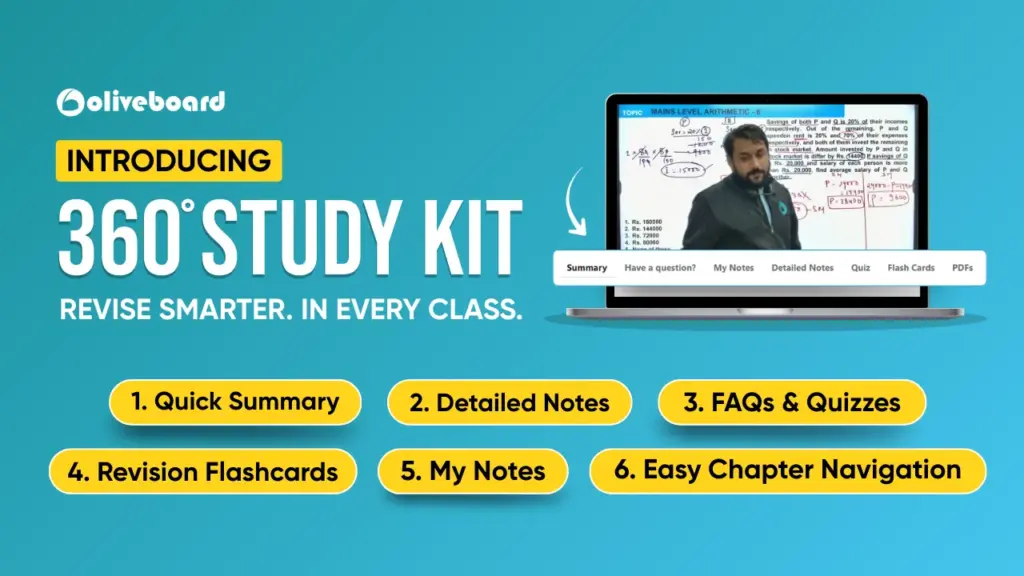
Start using the 360° Study Kit after every class for retention (notes, practice, revision, tests). and finish your revision in just 10 minutes.
4. Indian Economy One Liner Facts
Economics section tests basic concepts and schemes.
| Topic | One-Liner Fact |
|---|---|
| RBI Established | 1935 |
| Planning Commission Replaced By | NITI Aayog in 2015 |
| First Five-Year Plan Focus | Agriculture |
| GDP Full Form | Gross Domestic Product |
| Current Base Year for GDP Calculation | 2011–12 |
| Union Budget Presentation | Annually in Parliament |
| Fiscal Deficit Definition | Total expenditure – total revenue (excluding borrowings) |
| Current Fiscal Deficit Target | As per Union Budget 2025–26 (Check latest) |
| Inflation Measurement | Consumer Price Index (CPI) & Wholesale Price Index (WPI) |
| Repo Rate | Rate at which RBI lends to commercial banks |
| Reverse Repo Rate | Rate at which RBI borrows from banks |
| Cash Reserve Ratio (CRR) | Minimum % of deposits banks keep with RBI |
| Statutory Liquidity Ratio (SLR) | Minimum % of liquid assets banks maintain |
| Money Supply Measurement | M1, M2, M3 |
| Goods and Services Tax (GST) | 101st Constitutional Amendment, 2016 |
| Major GST Slabs | 5%, 12%, 18%, 28% |
| Exports Major Commodity | Petroleum products, Gems & Jewellery, Engineering goods |
| Imports Major Commodity | Crude oil, Gold, Electronics |
| FDI Policy | Automatic and government route as per sector |
| National Income Components | GDP, GNP, NNP, NI at Factor Cost |
| GNP Definition | GDP + Net Income from Abroad |
| NNP Definition | GNP – Depreciation |
| Money Market Instruments | Treasury bills, Commercial papers, Call money |
| Capital Market Instruments | Stocks, Bonds, Debentures |
| Financial Institutions | RBI, SIDBI, NABARD, EXIM Bank |
| NABARD Established | 1982 for agricultural & rural development |
| SEBI Established | 1992, Regulates securities market |
| Inflation Targeting | 4% ± 2% (Monetary Policy) |
| Current Account Deficit | Imports > Exports in a financial year |
| Economic Growth Definition | Increase in Real GDP |
| Poverty Line Definition | Minimum income level for basic living |
| Minimum Wages | Defined under Minimum Wages Act, 1948 |
| MGNREGA | Employment guarantee scheme launched in 2005 |
| PM-KISAN | Direct income support to farmers |
| Atmanirbhar Bharat | Self-reliant India initiative launched 2020 |
| Make in India | Manufacturing promotion initiative launched 2014 |
| Skill India | Mission for skilling youth, launched 2015 |
| Digital India | Initiative for e-governance, launched 2015 |
| Startup India | Launched 2016 for entrepreneurship |
| Financial Inclusion | Jan Dhan Yojana, 2014 |
| Pradhan Mantri Awas Yojana | Affordable housing scheme |
| UPI Full Form | Unified Payments Interface |
| Inflation Measured By | CPI and WPI |
| Monetary Policy Committee | Decides repo and reverse repo rates |
| RBI Governor | Head of Reserve Bank of India |
| Fiscal Policy | Government policy on taxation & expenditure |
| Direct Taxes | Income Tax, Corporate Tax |
| Indirect Taxes | GST, Customs Duty, Excise Duty |
| Public Sector Banks | Nationalized banks in India |
| Private Sector Banks | ICICI, HDFC, Axis, Kotak |
| Disinvestment in India | Sale of government shares in PSUs |
| Rural Economy Contribution | Agriculture & Allied Sectors |
| Industrial Economy Contribution | Manufacturing, Mining, Energy |
| Service Sector Contribution | IT, Banking, Tourism, Transport |
5. General Science One Liner Facts
Science questions are mostly conceptual or factual from Physics, Chemistry or Biology. Revise these quickly.
| Topic | One-Liner Fact |
| Father of Genetics | Gregor Mendel |
| Chemical Name of Table Salt | Sodium Chloride |
| Speed of Light | 3 × 10⁸ m/s |
| SI Unit of Force | Newton |
| First Man in Space | Yuri Gagarin |
| Chemical Formula of Water | H₂O |
| Atomic Number of Hydrogen | 1 |
| SI Unit of Pressure | Pascal |
| Unit of Electric Current | Ampere |
| Acceleration due to Gravity | 9.8 m/s² |
| Chemical Symbol of Gold | Au |
| Human Body’s Largest Organ | Skin |
| Blood Groups Discovered By | Karl Landsteiner |
| Neuron | Basic unit of Nervous System |
| Photosynthesis Occurs In | Chloroplast |
| Formula for Density | Mass/Volume |
| Boiling Point of Water | 100°C at 1 atm |
| Freezing Point of Water | 0°C at 1 atm |
| pH of Pure Water | 7 |
| Force = Mass × Acceleration | Newton’s Second Law |
| First Artificial Satellite | Sputnik 1 |
| Newton’s First Law | Law of Inertia |
| Newton’s Third Law | Action = Reaction |
| Unit of Energy | Joule |
| SI Unit of Temperature | Kelvin |
| Human Body Largest Gland | Liver |
| Smallest Bone in Human Body | Stapes |
| Blood Circulation Discovered By | William Harvey |
| Human Chromosome Count | 46 |
| DNA Full Form | Deoxyribonucleic Acid |
| Vitamin C Source | Citrus Fruits |
| Vitamin D Source | Sunlight |
| Vaccination Invented By | Edward Jenner |
| Antibiotic Discovered By | Alexander Fleming |
| Planet Closest to Sun | Mercury |
| Planet Known as Red Planet | Mars |
| Unit of Frequency | Hertz |
| Speed of Sound | 343 m/s in Air |
| Gas Used in Fire Extinguishers | Carbon Dioxide |
| Most Abundant Gas in Atmosphere | Nitrogen |
| Neutron Discovered By | James Chadwick |
| Electron Discovered By | J.J. Thomson |
| Proton Discovered By | Ernest Rutherford |
| Unit of Electric Resistance | Ohm |
| SI Unit of Power | Watt |
| SI Unit of Work | Joule |
| SI Unit of Magnetic Field | Tesla |
| Boiling Point of Ethanol | 78°C |
| Common Name of NaHCO₃ | Baking Soda |
| Common Name of CaCO₃ | Limestone |
| Blood Circulation Type | Closed Circulatory System |
6. Current Affairs (Last 1 Year)
Most questions are asked from the past 6-12 months in SSC CGL Exam Tier 2 stage.
| Topic Area | One‑Liner Current Affairs Fact (2025–26) |
| President of India | Droupadi Murmu is the President of India (ongoing tenure). |
| RBI Governor | Sanjay Malhotra is the RBI Governor (appointed Dec 2024, serving in 2025–26). |
| GDP Growth | India’s FAE projects ~7.4% real GDP growth for FY26. |
| AI Impact Summit 2026 | India is hosting the AI Impact Summit 2026 to strengthen global AI leadership. |
| World Environment Day 2025 | Theme: Beat Plastic Pollution on June 5, 2025 (UNEP global focus). |
| National Water Awards 2025 | President conferred Sixth National Water Awards for water conservation efforts. |
| Climate Change Ranking | India ranked 23rd in the 2026 Climate Change Performance Index. |
| International Tiger Day 2025 | India highlighted tiger conservation and doubling tiger population. |
| India’s Global Economy | India became the world’s 4th largest economy overtaking Japan (2025). |
| RBI Liquidity Measures | RBI to inject ~$23 billion liquidity via bond purchases and repos. |
Check detailed SSC CGL Syllabus to know more about other subjects.
7. Static GK Capitals, Rivers, and Dams
Easy to memorize and often repeated in SSC exams.
| Category | One‑Liner Fact |
| Capital of Arunachal Pradesh | Itanagar |
| Capital of Assam | Dispur |
| Capital of Bihar | Patna |
| Capital of Chhattisgarh | Raipur |
| Capital of Gujarat | Gandhinagar |
| Capital of Haryana | Chandigarh |
| Capital of Himachal Pradesh | Shimla |
| Capital of Jharkhand | Ranchi |
| Capital of Karnataka | Bengaluru |
| Capital of Kerala | Thiruvananthapuram |
| Capital of Madhya Pradesh | Bhopal |
| Capital of Maharashtra | Mumbai |
| Capital of Odisha | Bhubaneswar |
| Capital of Punjab | Chandigarh |
| Capital of Rajasthan | Jaipur |
| Capital of Tamil Nadu | Chennai |
| Capital of Telangana | Hyderabad |
| Capital of Uttar Pradesh | Lucknow |
| Capital of West Bengal | Kolkata |
| Largest Dam in India | Tehri Dam (Uttarakhand) |
| Second Largest Dam in India | Bhakra Nangal Dam (Himachal/ Punjab) |
| Longest River in the World | Nile (note: in India, Ganga is the longest) |
| Longest River in India | Ganga |
| Largest River Basin in India | Ganga Basin |
| Longest River in Peninsular India | Godavari |
| Widest River in India | Brahmaputra |
| Highest Waterfall in India | Kunchikal Falls (Karnataka) |
| Highest Peak in India | Kanchenjunga (Sikkim) |
| Longest Glacier in India | Siachen Glacier |
| National Animal of India | Bengal Tiger |
| National Bird of India | Indian Peacock |
| National Flower of India | Lotus |
| National Fruit of India | Mango |
| National River of India | Ganga |
| Currency of Japan | Yen |
| Currency of USA | US Dollar |
| Currency of UK | Pound Sterling |
| Largest Island of India | Andaman |
| Largest Lake in India | Vembanad Lake (Kerala) |
| Largest Saltwater Lake in India | Chilika Lake (Odisha) |
| Thar Desert Located In | Rajasthan |
| Westernmost Point of India | Guhar Moti, Gujarat |
| Easternmost Point of India | Kibithu, Arunachal Pradesh |
| Northernmost Point of India | Siachen Glacier, Ladakh |
| Southernmost Point of India | Indira Point (Andaman & Nicobar) |
| Major Port on East Coast | Visakhapatnam Port |
| Major Port on West Coast | Mumbai Port |
| Indian State with Most Population | Uttar Pradesh |
| Smallest State by Area in India | Goa |
| Major Mineral Producing State (Coal) | Jharkhand |
| Major Mineral Producing State (Iron Ore) | Odisha |
| Highest Rainfall in India | Mawsynram, Meghalaya |
| Longest Road Tunnel in India | Atal Tunnel (Himachal Pradesh) |
| Highest Motorable Pass in India | Khardung La (Ladakh) |
8. Quick Revision Tips for GA
In the last days before the exam, smart SSC CGL GA Preparation can make all the difference. Follow these simple strategies:
- Revise static GK daily for 15–20 minutes to keep facts fresh in your memory.
- Focus on current affairs from the last 12 months, especially important government schemes, awards, and events.
- Attempt GA mock tests to identify your weak areas and improve speed and accuracy.
- Make short notes for each subject so you can revise quickly without flipping through multiple books.
- Go through one-liners daily before bed—they’re easy to recall and help reinforce key facts.
FAQs
Ans. Around 25 questions are asked in the General Awareness section, each carrying 3 marks.
Ans. Use Lucent’s GK, monthly current affairs PDFs, and one-liner revision notes like this blog.
Yes, questions are mainly from the past 6-12 months of current events.
Spend at least 30-40 minutes revising static GK and current affairs every day.
They are useful for revision, but practicing mock tests and previous year questions is also essential for better preparation.
- Average Problems for SSC Exams, Practice Questions with Solutions
- SSC CGL Previous Year General Awareness Questions in Quiz Format
- Top 100 SSC CGL General Awareness Questions, Download PDF
- 1000 SSC CGL General Knowledge Questions, Attempt Now
- IBPS PO vs SSC CGL vs RBI Assistant: Complete Comparison
- SSC CGL vs RBI Assistant: Salary Job Profile Comparison 2026 Guide
I’m Mahima Khurana, a writer with a strong passion for creating meaningful, learner-focused content especially in the field of competitive exam preparation. From authoring books and developing thousands of practice questions to crafting articles and study material, I specialize in transforming complex exam-related topics into clear, engaging, and accessible content. I have first hand experience of 5+ months in SSC Exams. Writing, for me, is not just a skill but a way to support and guide aspirants through their preparation journey one well-written explanation at a time.