IBPS Clerk Prelims Exam 2026
IBPS Clerk Prelims Exam on 10th & 11th October 2026
The IBPS Clerk Prelims Exam 2026 is scheduled for 10th and 11th October 2026. Candidates should complete their revision and practice with exam-level questions before the examination.
Download FREE IBPS Clerk Preparation Kit
Download IBPS Clerk PYPs
Download IBPS Clerk Previous Year Papers for Practice
Download IBPS Clerk Previous Year Papers to practise exam-level questions, understand the exam pattern, and improve speed and accuracy for the upcoming examination.
Download IBPS Clerk Previous Year Papers
The IBPS Clerk Salary 2026 is an important factor for candidates considering a career as a Customer Service Associate (CSA) in participating public sector banks. The post, earlier referred to as IBPS Clerk, offers a revised salary structure under the 12th Bipartite Settlement, along with Dearness Allowance (DA), House Rent Allowance (HRA), Special Allowance, Transport Allowance and other employee benefits. The starting basic pay is ₹24,050 per month, while the overall monthly salary varies depending on allowances, deductions and the place of posting.
IBPS Clerk Salary 2026
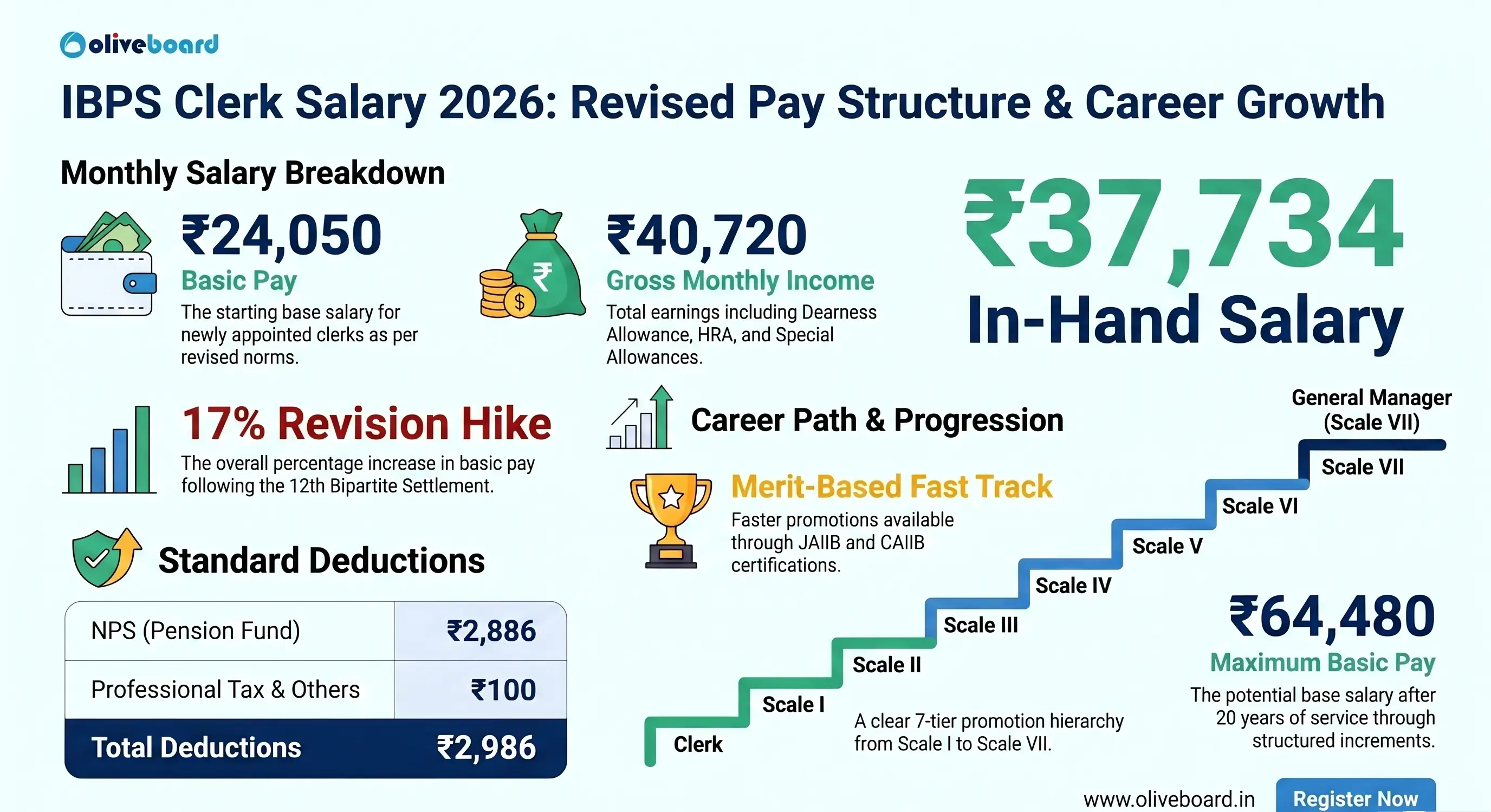
After the 12th Bipartite Settlement, the IBPS Clerk salary has been revised, with the basic pay now fixed at ₹24,050 per month, increased from the earlier ₹19,900. The salary progresses periodically through a structured pay scale and can reach up to ₹64,480 after around 20 years of service. Including allowances, the gross monthly salary is approximately ₹40,720.34, while the current in-hand salary comes to about ₹37,734 after standard deductions.
| Particular | Details |
|---|
| Post | Customer Service Associate (CSA) |
| Earlier Designation | IBPS Clerk |
| Starting Basic Pay | ₹24,050 |
| Maximum Basic Pay | ₹64,480 |
| Pay Scale | ₹24,050–₹64,480 |
| Major Allowances | DA, HRA, Special Allowance, TA and other benefits |
| Salary Growth | Annual increments and promotions |
| Posting | Participating Public Sector Banks |
What is the salary of a IBPS Clerk?
The IBPS Clerk Pay Scale is Rs. 24050- 1340/3- 28070- 1650/3- 33020- 2000/4- 41020-2340/7- 61800- 2680/1- 64480 (20 years). Apart from salary, clerks also enjoy additional benefits, a stable career path, and promotional avenues. In this article, we have covered the complete details of the IBPS Clerk salary structure, allowances, job profile, responsibilities, and career growth to help aspirants understand the role better.
| Particular | Details |
|---|
| Post Name | IBPS Clerk / Customer Service Associate |
| Conducting Body | Institute of Banking Personnel Selection |
| Pay Scale | ₹24,050 – ₹64,480 |
| Starting Basic Pay | ₹24,050 |
| Gross Salary | Approx. ₹40,720/month |
| In-Hand Salary | Approx. ₹37,700/month |
| Allowances | DA, HRA, Special Allowance, TA, Medical Benefits |
| Salary Revision | 12th Bipartite Settlement |
Attempt Free IBPS Clerk Mock Test
What changed in the IBPS Clerk salary after the 12th bipartite settlement?
After the 12th Bipartite Settlement, the IBPS Clerk basic pay was revised from ₹19,900 to ₹24,050; hike of approximately 17%. This is the most significant salary revision for clerical cadre banking employees in recent years and directly increases the gross and in-hand salary for all newly appointed clerks.
| Parameters | Before 12th BPS | After 12th BPS |
|---|
| Basic Pay | ₹19,900 | ₹24,050 |
| Pay Scale | ₹19,900–1000/1–20,900–1230/3–24,590–1490/4–30,550–1730/7–42,600–3270/1–45,930–1990/1–47,920 | ₹24,050–1340/3–28,070–1650/3–33,020–2000/4–41,020–2340/7–57,400–4400/1–61,800–2680/1–64,480 |
| Maximum Basic Pay | ₹47,920 | ₹64,480 |
| Salary Hike | — | 17% increase |
What is the salary structure for IBPS Clerk?
The IBPS Clerk Salary starts with a basic pay of ₹24,050 and, along with allowances like DA, HRA, and special allowance, the gross monthly salary reaches ₹40,720.34. After standard deductions of ₹2,986, the approximate in-hand salary is ₹37,734.34. This makes the clerical post financially stable with steady growth and benefits in public sector banks.
| Salary Component | Amount |
|---|
| Basic Pay | ₹24,050 |
| Dearness Allowance (DA) | ₹4,769 (approx.) |
| Special Allowance | ₹7,083 |
| House Rent Allowance (HRA) | ₹2,739 |
| Transport Allowance | ₹850 |
| TA-DA | ₹133 |
| Gross Salary | ₹40,720 |
| Deductions | ₹2,986 |
| In-Hand Salary | ₹37,734 |
What is the in-hand salary for IBPS Clerk?
The gross salary comes to around ₹40,720 after adding allowances like Dearness Allowance (DA), House Rent Allowance (HRA), and Special Allowance. After standard deductions such as NPS contribution and union fees (around ₹2,986), the net take-home salary is about ₹37,734, which may vary slightly depending on the place of posting and allowances.
What is the IBPS Clerk Pay Scale?
The IBPS Clerk pay scale starts with a basic pay of ₹24,050 under the 12th Bipartite Settlement. With structured annual increments, the salary gradually increases and can reach a maximum basic pay of ₹64,480 over 20 years of service. Along with allowances, the gross monthly salary is around ₹40,720, while the in-hand salary is approximately ₹37,734.
| Stage | Basic Pay (₹) | Increment | Duration |
|---|
| Initial | 24,050 | 1,340 yearly | 3 years |
| After 3 years | 28,070 | 1,650 yearly | 3 years |
| After next 3 years | 33,020 | 2,000 yearly | 4 years |
| After next 4 years | 41,020 | 2,340 yearly | 7 years |
| After next 7 years | 57,400 | 4,400 yearly | 1 year |
| After next 1 year | 61,800 | 2,680 yearly | 1 year |
| Maximum Basic Pay | 64,480 | — | — |
Solve IBPS Clerk Previous Year Papers
What allowances are there for IBPS Clerk?
IBPS Clerks receive several allowances on top of their basic pay. These allowances vary based on the posting location and city tier. All percentage rates below are approximate as per the 12th Bipartite Settlement.
| Allowance | Rate / Amount (approx.) |
|---|
| Dearness Allowance (DA) | 19.83% of basic pay; revised quarterly |
| Special Allowance | 7.5% of basic pay |
| House Rent Allowance — Metro cities | 8.5% of basic pay |
| House Rent Allowance — Cities above 5 lakh population | 7.5% of basic pay |
| House Rent Allowance — Other cities | 6.5% of basic pay |
| Transport Allowance (TA) | Fixed monthly amount |
| Medical Allowance | ₹2,000 per year (fixed, paid annually) |
| Travel Reimbursement | For official tours and travel, as per actuals |
What deductions are there in the IBPS Clerk salary?
The total monthly deduction from an IBPS Clerk's salary is approximately ₹2,986. This is lower than deductions for officer-grade posts and is one of the reasons the clerical cadre in-hand salary is relatively close to the gross. Here is the breakdown:
| Deduction Component | Amount (₹, approx.) |
|---|
| Pension Fund Contribution (NPS) | 2,886 |
| Death Relief Fund | 40 |
| Professional Tax | 60 |
| Total Deductions | ~2,986 |
Note: Professional tax may vary by state; some states charge higher rates. The NPS contribution also earns a matching employer contribution, which is a long-term financial benefit.
IBPS Clerk Pay Scale with Increments
As per the 12th Bipartite Settlement, the IBPS Clerk pay scale ranges from ₹19,900 to ₹47,920. The basic pay increases at regular intervals with fixed annual increments. The first increment is ₹1,000 per year for the initial years, which later increases to ₹1,230 and ₹1,330 based on years of service. This well-structured pay progression ensures financial growth and rewards loyalty. Employees also become eligible for promotion and higher allowances with tenure.
IBPS Clerk Annual Salary Package 2026
The annual salary package of an IBPS Clerk includes the monthly gross salary along with various allowances and employee benefits. Based on the current salary structure, an IBPS Clerk receives an approximate gross monthly salary of ₹40,720, which translates to an annual gross salary of around ₹4.88 lakh. The overall package increases further with benefits such as medical facilities, leave benefits, NPS contributions, and other banking employee perks.
| Salary Component | Amount (Approx.) |
|---|
| Monthly Basic Pay | ₹24,050 |
| Monthly Gross Salary | ₹40,720 |
| Annual Gross Salary | ₹4,88,640 |
| Annual In-Hand Salary | ₹4.5 lakh (Approx.) |
| Additional Benefits | Medical facilities, NPS benefits, leave benefits, travel benefits, loan facilities |
IBPS Clerk Annual Increment Structure
The IBPS Clerk salary increases every year through a structured annual increment system under the revised pay scale. The increment amount varies across different stages of service, ensuring a steady increase in basic pay and overall monthly salary. As the basic pay rises, allowances such as Dearness Allowance (DA), House Rent Allowance (HRA), and Special Allowance also increase, resulting in better in-hand salary and long-term financial growth.
| Years of Service | Annual Increment | Basic Pay Reached |
|---|
| At Joining | — | ₹24,050 |
| After 1st Year | ₹1,340 | ₹25,390 |
| After 2nd Year | ₹1,340 | ₹26,730 |
| After 3rd Year | ₹1,340 | ₹28,070 |
| After 4th Year | ₹1,650 | ₹29,720 |
| After 5th Year | ₹1,650 | ₹31,370 |
| After 6th Year | ₹1,650 | ₹33,020 |
| After 10th Year | ₹2,000 | ₹41,020 |
| After 17th Year | ₹2,340 | ₹61,800 |
| Maximum Basic Pay | ₹2,680 | ₹64,480 |
What is the work of an IBPS clerk?
The IBPS Clerk role is also known as Single Window Operator because clerks handle multiple banking functions from a single counter. After selection, you will be responsible for the following duties:
| Responsibility | What it involves |
|---|
| Customer Service | Handling customer queries, passbook updates, complaints, and account guidance |
| Cash Management | Deposits, withdrawals, and day-to-day cash transactions |
| Account Handling | Opening new accounts, issuing demand drafts (DDs) and bank statements |
| Document Verification | Checking and verifying identity proofs, address proofs, and other documents |
| Ledger Maintenance | Maintaining financial records, balance sheets, and bank registers |
| Treasury Work | Assisting with treasury-related tasks as directed by senior officers |
| ATM and Passbook Services | Issuing ATM cards, updating passbooks, and handling ATM-related queries |
| Sanctioning Withdrawals | Approving routine withdrawal requests from customers |
IBPS Clerk Salary Growth: Year-Wise Salary After Joining
Many candidates want to know how the salary of an IBPS Clerk increases after joining. The salary grows through annual increments, Dearness Allowance (DA) revisions, and promotions. The basic pay follows a structured pay scale, increasing from ₹24,050 at the time of joining and reaching up to ₹64,480 after completing the complete scale progression.
| Experience | Approximate Basic Pay | Expected In-Hand Salary |
|---|
| Joining Year | ₹24,050 | ₹37,000–₹40,000 |
| After 5 Years | ₹33,000+ | ₹45,000–₹50,000 |
| After 10 Years | ₹41,000+ | ₹55,000–₹60,000 |
| After 15+ Years | ₹57,000+ | ₹70,000+ |
IBPS Clerk Career Growth
IBPS clerks have excellent promotion opportunities through two main paths:
1. Normal/Seniority-Based Promotion
- Internal written exam after 2 years of service
- No need for JAIIB/CAIIB certifications
- Promoted to Trainee Officer, then to Probationary Officer (PO)
2. Merit-Based Promotion
- Requires JAIIB & CAIIB certifications (by IIBF)
- Based on performance, certifications, and bank requirements
IBPS Clerk Promotion Hierarchy
The IBPS Clerk promotion hierarchy is as follows:
- Bank Clerk
- Officer/Assistant Manager (Scale I)
- Manager (Scale II)
- Senior Manager (Scale III)
- Chief Manager (Scale IV)
- Assistant General Manager (Scale V)
- Deputy General Manager (Scale VI)
- General Manager (Scale VII)
IBPS Clerk Salary and Benefits for New Joinees
The revised clerical salary makes the IBPS CSA post attractive for graduates seeking a stable banking career. Apart from basic pay, employees are eligible for applicable allowances and perks under the participating bank's rules, while the salary can increase with increments and career progression. The actual take-home amount, however, should not be treated as a fixed figure because deductions and location-based allowances can change the monthly pay.
What is the IBPS Clerk training period salary?
All selected candidates have to undergo a probation or training period of 6 months after joining. During this time, they receive a consolidated stipend of ₹24,050 per month. Though the full benefits and allowances are not provided at this stage, basic facilities like NPS deduction and initial service-related support begin. The probation period allows candidates to understand the work culture and basic clerical functions of the bank. Upon successful completion, they are eligible for the regular pay scale.
Join IBPS Clerk Online Coaching
IBPS Clerk Salary After 5 Years
Many candidates want to know the salary growth after joining as a clerk. Due to yearly increments, DA revisions, and allowance increases, the salary gradually improves.
| Experience | Expected Salary |
|---|
| At Joining | ₹37,000–₹39,000/month |
| After 3 Years | ₹42,000+ |
| After 5 Years | ₹45,000–₹50,000/month |
| After 10 Years | ₹55,000–₹60,000/month |
What is the IBPS Clerk salary after 10 years?
After 10 years of service, the basic pay reaches approximately ₹41,020, entering the fourth increment slab. With proportionally higher DA and allowances on this revised basic, the approximate in-hand salary is ₹55,000–₹60,000 per month. Clerks who have received one promotion within 10 years, which is common through the merit-based or seniority path, will be earning significantly more as Officer Scale-I. These are approximate figures, and actual salary depends on DA rates at that time and your posting.
IBPS Clerk Salary After 12 Years
After 12 years of service, an IBPS Clerk (Customer Service Associate) reaches Stage 12 under the 12th Bipartite Settlement, where the basic pay increases to ₹43,360. Along with annual increments, employees receive Dearness Allowance (DA), Special Allowance, Transport Allowance, Learning Allowance, and other admissible benefits. Based on the latest salary structure, the indicative gross monthly salary is approximately ₹71,950, though the exact in-hand salary may vary depending on the city of posting, deductions, and bank-specific allowances. Employees who clear JAIIB/CAIIB examinations or earn promotions can expect even higher earnings over the course of their career.
Does the IBPS Clerk salary vary by location?
Yes, the IBPS Clerk salary varies by posting location because HRA is calculated as a percentage of basic pay, and the rate differs by city tier. A clerk posted in a metro city gets 8.5% HRA, while a clerk in a smaller town gets only 6.5%. On a basic pay of ₹24,050, this difference alone is approximately ₹480 per month. Over a year that adds up to around ₹5,700. The table below gives approximate in-hand salary by city type.
| City Tier | HRA Rate | Approx. In-Hand Salary |
|---|
| Metro (Mumbai, Delhi, Kolkata, etc.) | 8.5% of basic | ₹39,000–₹40,500 |
| Large City (above 5 lakh population) | 7.5% of basic | ₹38,500–₹39,500 |
| Other Cities / Rural | 6.5% of basic | ₹37,500–₹38,500 |