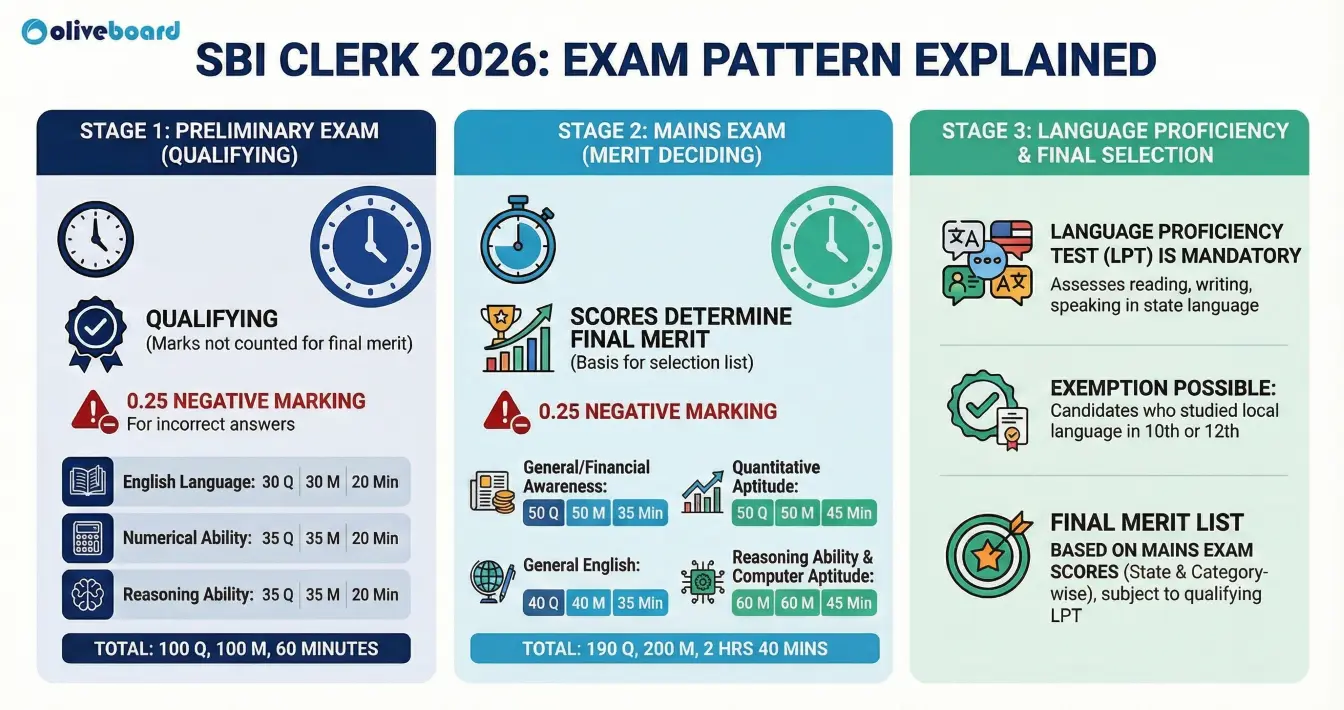
The SBI Clerk Exam 2026 will follow a three-stage process: Preliminary, Mains, and a Language Proficiency Test (LPT). The prelims are qualifying in nature, while the mains score determines the final merit. Candidates must also clear the LPT to demonstrate proficiency in the local language of their applied state to secure the position of Junior Associate.
What is the new SBI Clerk Exam Pattern 2026?
The new SBI Clerk exam pattern consists of three stages: Preliminary Exam, Mains Exam, and Language Proficiency Test (LPT). Candidates must qualify for each stage to be selected as a Junior Associate in the State Bank of India (SBI).
- Preliminary Examination
- Mains Examination
- Language Proficiency Test (LPT)
What is the SBI Clerk Prelims Exam Pattern?
The preliminary examination is the first stage of the SBI Clerk selection process. It is an online objective test with three sections: English Language, Numerical Ability, and Reasoning Ability.
- Each question carries one mark.
- Negative marking: 0.25 marks deducted for each incorrect answer.
- The test is available in English, Hindi, and regional languages.
| Serial No. | Section | No. of Questions | Marks | Duration |
|---|
| 1 | English Language | 30 | 30 | 20 minutes |
| 2 | Numerical Ability | 35 | 35 | 20 minutes |
| 3 | Reasoning Ability | 35 | 35 | 20 minutes |
| Total | - | 100 | 100 | 60 minutes |
Attempt SBI Clerk Mock Test for Free
What is the SBI Clerk Mains Exam Pattern?
Candidates who clear the preliminary examination are eligible for the mains exam. It is also an online objective test, covering four sections: general/financial awareness, general English, quantitative aptitude, and reasoning ability & computer aptitude.
- Each question carries one mark except in Reasoning & Computer Aptitude, where some questions may have higher weightage. Check SBI Clerk Syllabus in detail.
- Negative marking: 0.25 marks deducted for each incorrect answer.
- The test is available in English, Hindi, and regional languages.
| Serial No. | Section | No. of Questions | Marks | Duration |
|---|
| 1 | General/Financial Awareness | 50 | 50 | 35 minutes |
| 2 | General English | 40 | 40 | 35 minutes |
| 3 | Quantitative Aptitude | 50 | 50 | 45 minutes |
| 4 | Reasoning Ability & Computer Aptitude | 50 | 60 | 45 minutes |
| Total | 190 | 200 | 2 hours 40 minutes |
How is the SBI Clerk Language Proficiency Test (LPT) conducted?
The SBI Clerk Language Proficiency Test is conducted to assess candidates' ability to read, write, and speak the official language of the state/UT they have applied for.
- Candidates must qualify LPT to be considered for final selection.
- It may involve reading comprehension, short essay writing, and verbal skills.
- Exemption: Those who studied the local language in 10th or 12th standard may be exempted.
| Sl. | Test | Pattern | No. of Passages | No. of Questions | Max. Marks |
|---|
1 | Non-Verbal Test | Objective | 3 | 15 | 15 |
| Subjective | 3 | 15 | 15 |
| 2 | Verbal Test | - | - | 20 | 20 |
Solve SBI Clerk Previous Year Paper
What is the final selection process for SBI Clerk?
Final selection is based on mains exam scores only (prelims scores are not considered for final merit).
- Final selection is based on marks obtained in the Mains Exam only and performance in LPT.
- Preliminary scores are not considered for final merit.
- Candidates must also qualify the LPT to be provisionally selected.
- The final merit list is prepared state-wise and category-wise.
Enroll in SBI Clerk Online Coaching Now
Key Takeaways
Here are the key takeaways:
- The SBI Clerk 2026 selection has three stages: Prelims, Mains, and LPT.
- Prelims has 3 sections: English, Numerical Ability, and Reasoning, totaling 100 marks.
- Mains has 4 sections: General/Financial Awareness, English, Quantitative Aptitude, and Reasoning & Computer Aptitude for a total of 200 marks.
- LPT tests reading, writing, and speaking in the local language; some candidates may be exempted.
- Final selection is based on Mains scores and LPT; Prelims marks are not counted.
- The final merit list is prepared state-wise and category-wise.